
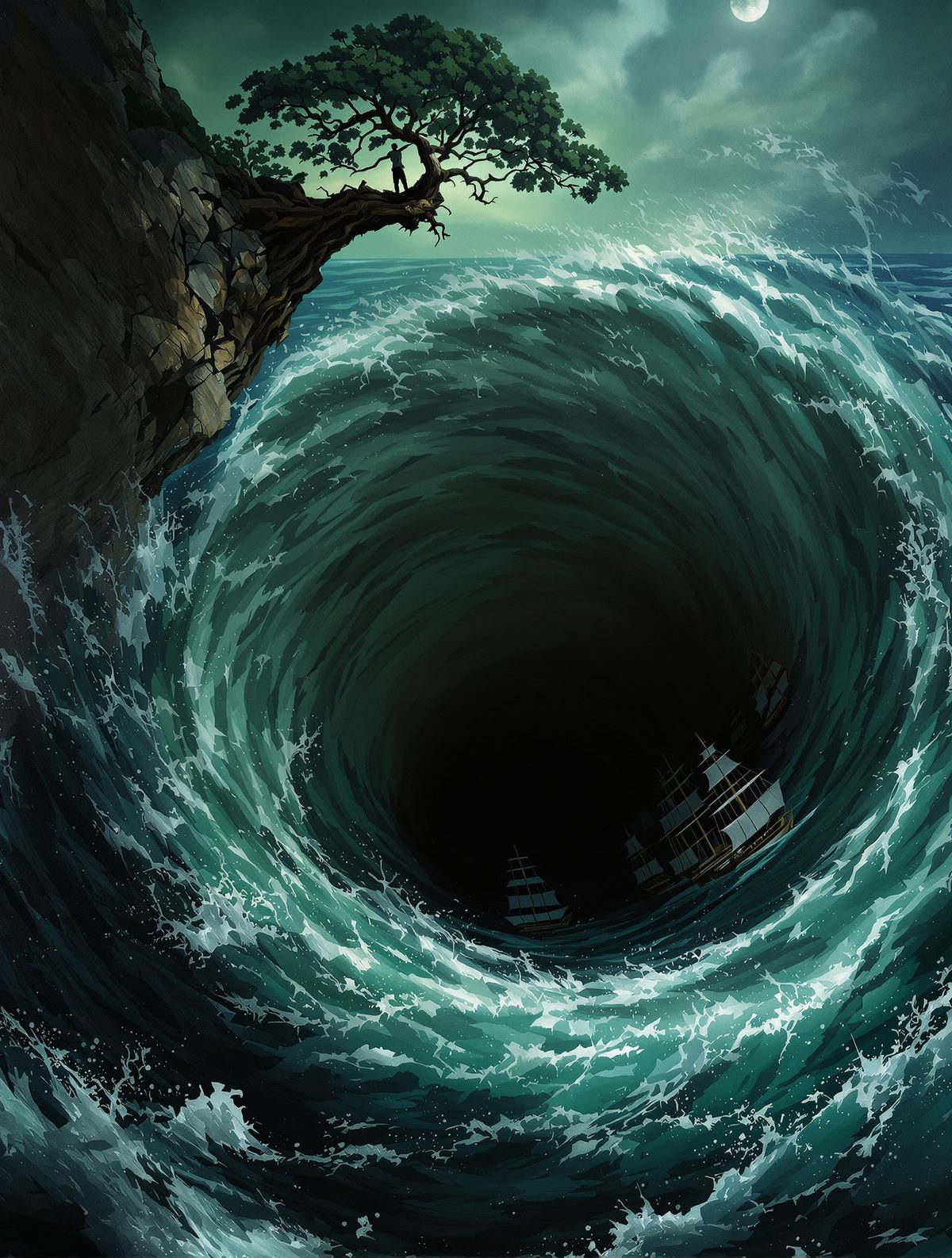
The gaping maw of Charybdis. In the swirling depths, where the Ionian Sea narrows to form what ancient Greeks called the Strait of Messina, lurks a terror of timeless renown. She was not scaled nor clawed, yet by her nature more terrifying than any beast of flesh and bone. Charybdis, the mighty whirlpool, lay in eternal wait to gulp the very sea and its trespassers thrice a day. Her reputation, etched in epic poetry, has become something all sailors cursed with a need to navigate these waters knew well: around Charybdis, it was not a matter of if you would face her, but how.
The Hungry Throat of the Sea
According to Greek mythology, Charybdis was born of divine lineage. She was said to be a daughter of Poseidon and Gaia, molded by powers that irrevocably linked her to the seas she inhabited. This illustrious ancestry did not guarantee her a place in the pantheon, but rather immortalized her as a devourer of the waters. Homer tells us in his Odyssey that three times a day, Charybdis would open her vast, vacuous mouth, consuming whole the sea and anything afloat upon it — ships, men, and fortune.
Imagine, if you will, a placid sea abruptly buckling, waves folding in upon themselves before cascading into a ravenous vortex. It was the feared siren call of Charybdis, which would seize any vessel near the rocks of modern-day Sicily, only to spit it out in shreds as the waters belched violently back to the surface.
Awarding the Odyssey's Odium
Presented with this Herculean threat was Odysseus, the archetypal hero of Homeric lore. While navigating back to Ithaca, he faced the grim challenge of traversing the strait on which Charybdis dwelled. To skirt the clutches of a creature who swallows the sea itself, Odysseus and his men had but one desperate tactic — attempt the nearly impossible by sailing close to the cliffs of Scylla, another formidable creature.
Guided by the sorceress Circe's grim advice, Odysseus opted for sacrificing six men to Scylla rather than losing the entire ship to Charybdis. Yet, as if further testing his wit and vigilance, fate led him face-to-face with Charybdis after all. Clinging to nothing more than a fig tree rooted in the cliff's side as his vessel met its ends below, Odysseus waited for the debris to reemerge — a testament both to his endurance and Charybdis's terror.
Myths Wrought in Ocean Currents
While the origin of Charybdis is steeped in myth, her placement in the very-real Strait of Messina opens a portal to understanding how seafaring knowledge intersects with mythology. Situated between mainland Italy and Sicily, this narrow passage has historically been a lifeline for trade and conquest, a perilous avenue pocked with eddies and unpredictable undercurrents that could easily wreck an ancient craft.
The ancients were astutely aware of these maritime headaches, and through mythology, they codified their perils for posterity. Every retelling of Charybdis's tale was not merely an embellishment but a survival lesson, an encoding of seafaring wisdom turned legend.
The Jaws of Geographical Reality
Though many dismiss myths as the fanciful imaginings of pre-modern minds, anthropologists and historians shed light on their deeper truths. The tales of Charybdis were, in essence, the ancients' way of humanizing and confronting the chaotic realities of nature they could not otherwise control. Charybdis represents an allegorical language of the sea, a manifestation of fear, and awe projected into an entity that sailors could endeavor to outwit.
Even today, the Strait of Messina poses challenges to modern mariners. Though its whirlpools may not consume entire ships in an arm's breadth, their power remains formidable. The strait's peculiar geography, combined with tide and current, produces whirlpools that inspired the likes of Charybdis, bridging mythic symbol and palpable reality into one.
Legacy of a Mythic Metaphor
Why do tales of Charybdis continue to resonate? Because they are more than mere relics of an archaic world; they are gateways to understanding human resilience against forces beyond our control. Beyond the veil of myth, Charybdis serves as an ever-present metaphor for the challenges we encounter — the consuming voids that roar uneasily beneath the surface of calm waters in the journey of life.
Through the lens of this myth, we are reminded of Odysseus's strategy: to navigate wisely, to respect and understand the power of nature — both its boons and its barefaced animosities. Charybdis teaches the value in accepting that not all battles require victory, only survival. As ancient legends go, there are few so vividly cautionary and yet startlingly pertinent to the modern psyche as the throat that swallowed the sea.