In the vast silence of the early cosmos, before the first ripple of life or the earliest whispers of civilization, there existed a space of unending darkness—a void that defied comprehension. Amidst this primordial chaos, one entity emerged from obscurity, and through the power of a solitary act, instigated the grand tapestry of life and myth that would follow. This entity was Atum, the first god of ancient Egyptian mythology, whose solitary utterance began the symphony of creation.
The Primal Ocean: Amunet’s Enigma
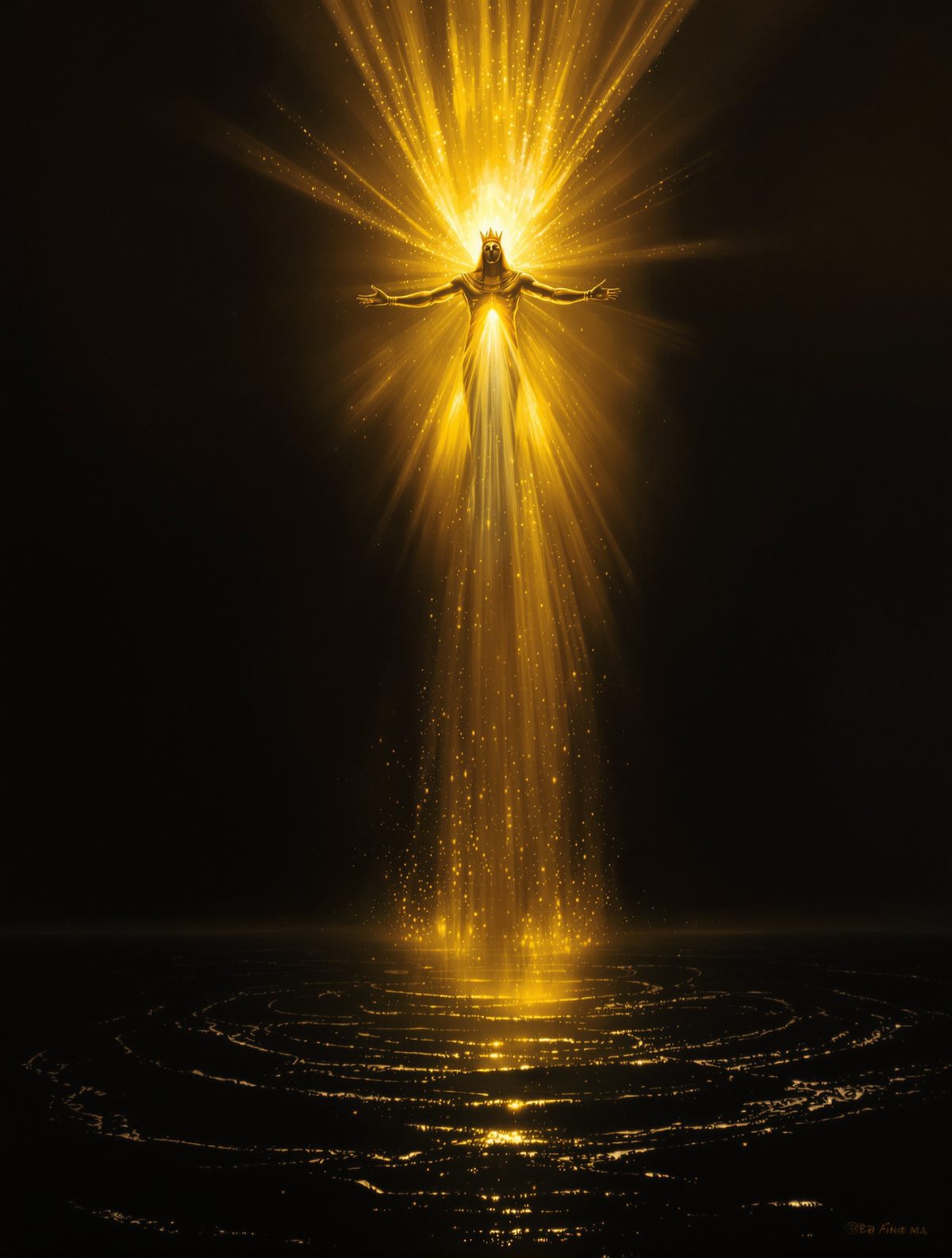
At the dawn of everything, there was only Nun—the limitless, churning waters that veiled the universe in enigmatic potential. This was the primal ocean, a boundless expanse where order held no dominion, and time itself seemed an inconceivable notion. It was within this swirling abyss that Atum lingered, without substance or shape, a singularity of potential energy waiting to ignite the cosmic dance.
This liquid nothingness was both a cradle and a challenge. There were no sky, no earth, and no distinguishing landmarks save the velvet darkness stretching eternally. The Egyptians revered this concept as Nun, and they saw it as the birthplace of gods and men. Yet, it was Atum who broke the stillness, a nascent deity whose will to emerge transcended the isolation of his environment. He was not crafted by hands divine nor molded by necessity. His existence sprang from the self—a testament to the audacity of beginnings.
A Name Calls Itself Into Being
The legend swells with the narrative of Atum's remarkable self-creation, a manifestation without a creator, in an era where gods forged their identities against the pressing darkness. Unparalleled in his solitude, Atum whispered his own name into the silence, and this act resonated through the fabric of the nascent universe. To speak one’s own name is to assert existence, to affirm presence where there previously was none.
In a profound act of self-assertion, Atum’s name invoked his being, solidifying his presence amid the amorphous waters of Nun. This creative utterance split the nothingness, as consciousness gives birth to thought, thought gives rise to word, and word shapes reality. The ancient Egyptians revered language and sound as magical forces, capable of crafting worlds and defining destinies—a belief deeply entwined with Atum’s creation myth.
From Solitude to Duality: The First Offspring
Yet, even in his self-realization, Atum was alone, a solitary figure in a silent dreamscape. Understanding the necessity of balance and duality, Atum reached into himself and withdrew the first expressions of life. With a breath, he brought forth Shu, the god of air, and Tefnut, the goddess of moisture. These siblings emerged as complements—opposites that defined and reinforced each other, instigating the cycle of creation.
In the mythology, Shu’s emergence symbolized the first breath of existence, a gust that separated the sky from the waters. Tefnut, associated with primordial moisture, represented fertility and the inherent nurturing aspects of creation. Together, they initiated the stabilization of Atum’s developing universe, setting the stage for the earth and firmament to coalesce. The interplay of air and water thus became the vital polarity necessary for life to flourish, a concept that resonates with enduring cosmic symbolism.
A City of Gods: Heliopolis
Heliopolis, or On as the Egyptians called it, rose as the sacred city where Atum was most venerated. Situated near modern-day Cairo, Heliopolis stood as a sacred center, the nucleus of theological thought known as the Ennead. Within this city, priests chronicled the stories and fables that would become the pillar of ancient Egyptian spirituality.
In this epicenter, with its obelisks piercing the sky and temples echoing with prayers, Atum was celebrated as the grand patriarch of not only the Ennead—a group of nine deities he was said to have begotten—but also of creation itself. As the Lord of Heliopolis, Atum was acknowledged for the genesis narrative echoed throughout Egypt, linking his mythical deeds to the rhythms of every Nile flood and sunrise.
Beyond Myth: The Legacy of Self-Made Creation
The tale of Atum's genesis holds more than just mystical allure; it encapsulates profound truths about human endeavors and our understanding of creation. At its core, the legend of Atum reflects the Egyptian perception of self-creation as an empowering paradigm, recognizing the potential of self-realization even amidst overwhelming solitude.
Such myths remind us that beginnings need not spring from conflict but can emerge from conscious choice and affirmation. They underscore the power embedded in words and identity—how naming can birth realities and shape the world's order. The legacy of Atum inspires thoughts of self-determination and the transformative potential inherent in acknowledging one’s capacity to affect change.
As we traverse the centuries from the sands of ancient Egypt to our modern-world complexities, Atum’s solitary act remains a testament to the profound capacity for self-belief and creation. It compels us to ponder our boundaries and our roles as creators within our personal and collective narratives, reminding us that even in voids, existence can whisper itself into vivid being.