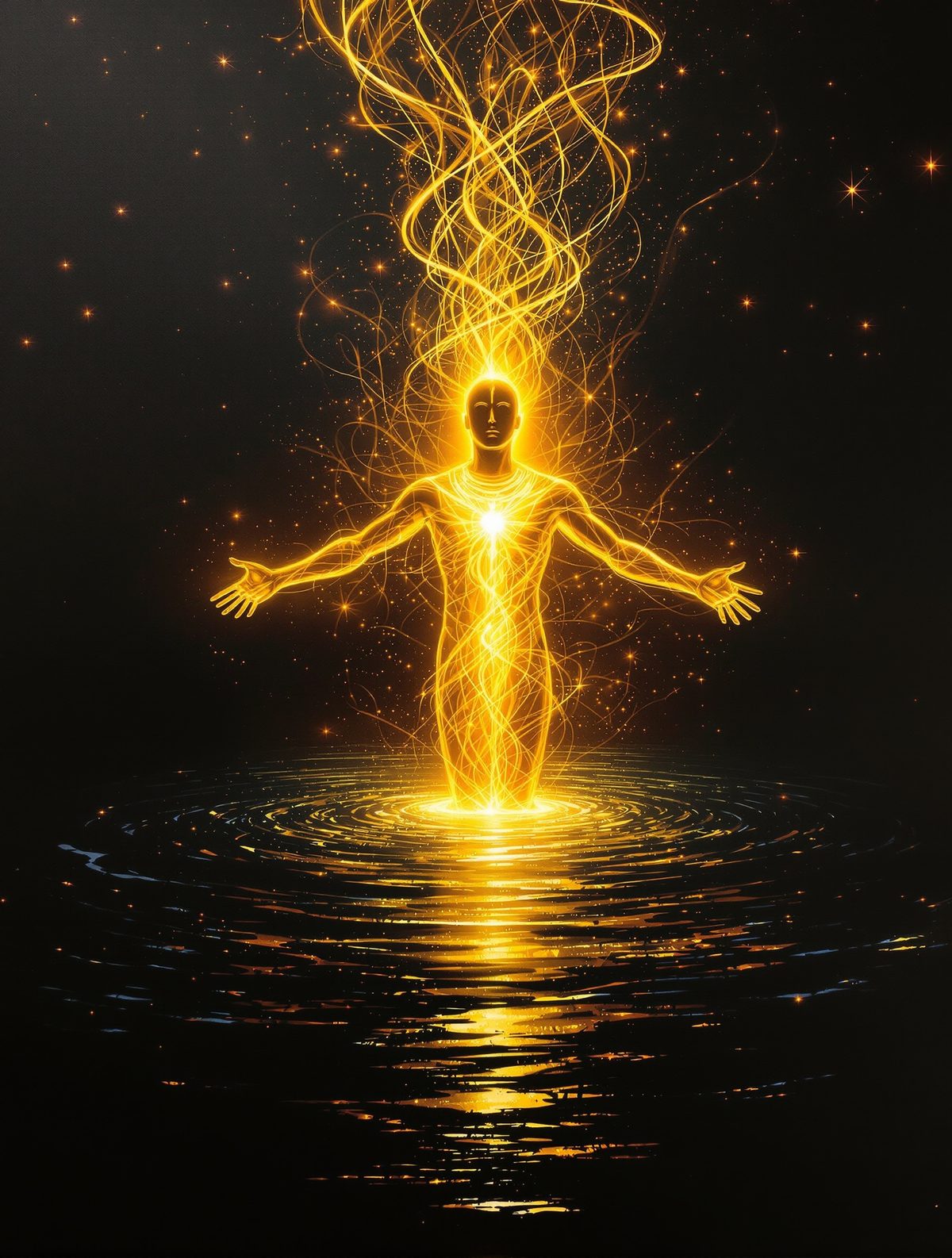
In a time shrouded by the primordial cloak of absence, before land kissed the sky and the sun found its trajectory, one god hovered alone in the vast, inky waters of Nun. This was Atum, the solitary spark of consciousness in a realm devoid of form and light. From the ample chest of this divine entity sprang not only the dawn of existence but a legend so profound that it has echoed across the millennia, whispered around the firesides of ancient Egypt.
The Waters of Nun
The ancients called it Nun, the boundless, formless abyss, a vast cosmic ocean predating all things. In the Egyptian cosmology, Nun was not just lifeless water but a chaotic, infinite sea teeming with potential. Here, before the concept of ground or sky, Atum drifted alone. There were no winds to whisper across these waters and no celestial orbs to reflect their destinations. Atum was self-created, existing without precedent or partner, a lighthouse of deity in a sea of void.
According to myth, Atum was both male and female, possessing the power of creation within himself. Yet, in this fertile solitude, he was driven by an omnipotent yearning for companionship, a profound loneliness that historians suggest is a motif not only of human experience but of cosmic beginnings.
Atum's Alchemical Duality
Such was the intensity of Atum's loneliness that he engaged in an act of passionate self-creation. He chose neither a spoken incantation nor a grand gesture, but rather, he released a mighty sneeze. Releasing the breath that filled his almighty lungs, Atum conjured from himself two children: Shu and Tefnut.
Shu, the god of air, marked the first breath of life given form, and Tefnut, the goddess of moisture, embodied the lifeblood of existence. This duality of elements—air and water—became the foundational pillars of Egyptian cosmology. These new deities were to shape the very elements that defined the physical world: the currents of breeze and the nurturing waters.
The library haunters may be keen to note that the very names of Shu and Tefnut bear significance, with Shu meaning “emptiness” or "he who rises up" and Tefnut representing “spitting out.” These words encapsulate the rawness and the spontaneity of Atum’s creation, reinforcing his status as a solitary father-mother figure
The Birth of Heaven and Earth
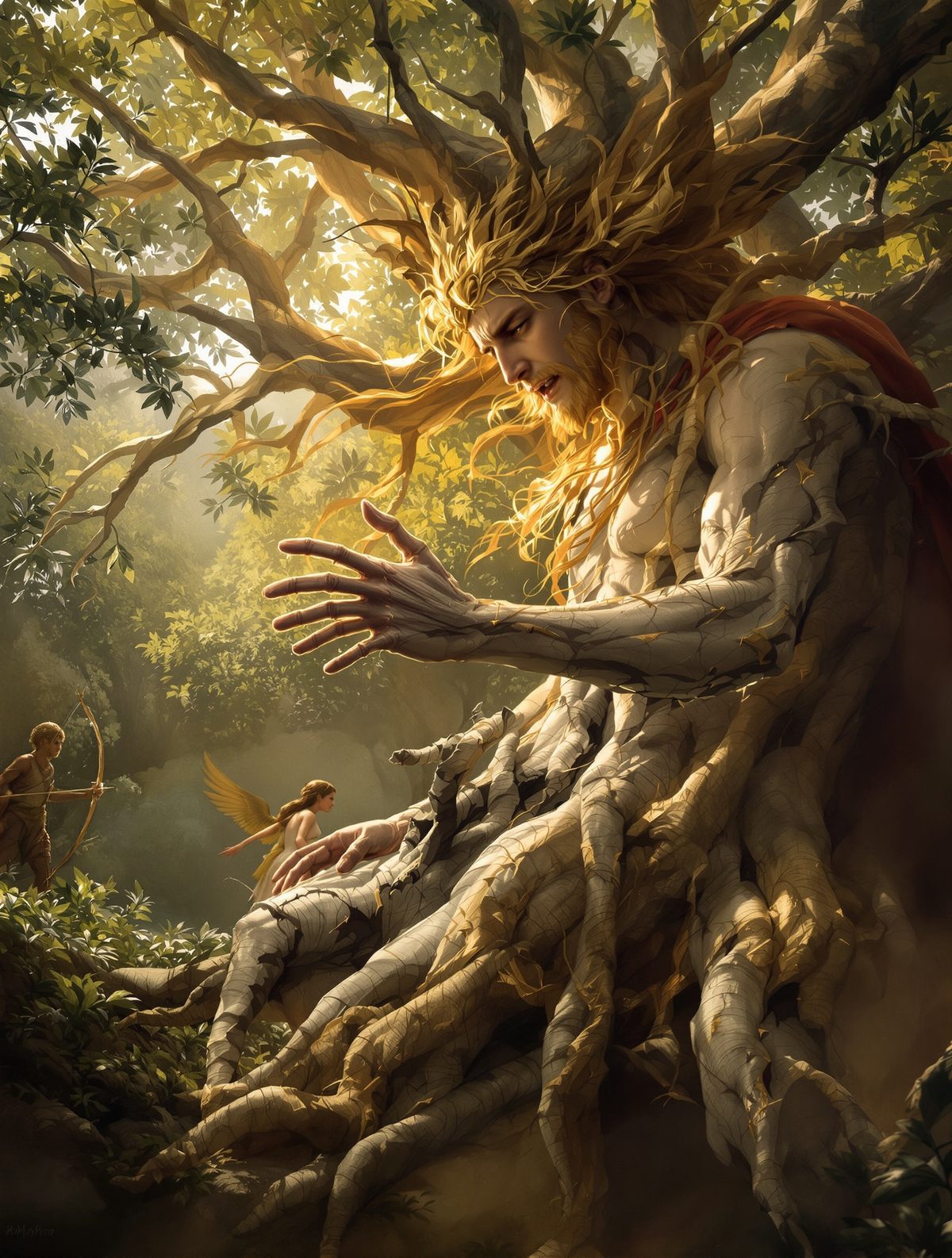
Reunited with his progeny, Atum formed the core of a divine family that expanded rapidly. From Shu and Tefnut came Geb and Nut, the earth and the sky. It was Geb, the mighty god of the earth, who stretched his mountainous arms to cradle the emerging land of Egypt, while Nut, his celestial counterpart, arched above him like a protective canopy.
In this mystical act of separation, a world began to take shape. Geb and Nut’s daily tension—a constant, divine push against one another—served to create and maintain the firmament, ensuring that chaos was kept at bay. Geb’s laughter became the quakes that would rend the earth, and Nut’s tears the rain that would nourish it.
This sacred pantheon crafted a narrative tapestry that suggested the very foundations of the natural world were born from the relationships of the gods. This profoundly anthropomorphic mythological structure served the ancient Egyptians to explain life’s mysteries and its ecological cycles, reinforcing their agricultural practices along the banks of the Nile.
Lost and Found: A Cosmic Tale
As an unrelated yet fascinating side note, in their quest to create mythological stories imbued with emotion and moral lessons, the Egyptians included an episode in which Shu and Tefnut were lost to the chaos of Nun, creating great disarray. During this time, Atum despaired, for his newly formed progeny had vanished into the all-consuming void. His heart heavy with sorrow, he sent his “Eye” to find them, illustrating one of the earliest accounts of the all-seeing eye symbolism so prevalent in later cultures.
In time, Shu and Tefnut returned, a jubilation that brought tears to Atum’s eyes. When these divine tears touched the earth, humanity emerged, marking mankind’s place in the vast eternal tale of creation. This narrative, much like a parable, spoke to the trials of loss and reunion, echoing in the lives of human families through time.
The Enduring Legacy of Atum's Creation
From Atum’s first act of creation, we see not only the birth of gods, but an intricate cosmology that guided one of history’s most brilliant civilizations. The story of Atum and his self-generated progeny serves as a profound metaphor for the resilience of life, the genesis of light and order from isolation and darkness.
In a contemporary context, Atum’s tale resonates through our understanding of beginnings. It imparts the notion that from loneliness and primordial voids can spring forth creativity, inspiration, and ultimately, the tapestry of life itself. As we flicker through time—creating, discovering, and sometimes feeling like solitary stars in an immense universe—perhaps Atum’s creation reminds us that from such seeming isolation emerges the interconnected web of existence itself.
Through the eyes of the ancients, Atum's solitude was not an end but a fertile ground for genesis, inviting us to view our own moments of solitude not as desolate, but as potential beckoning for new creation.