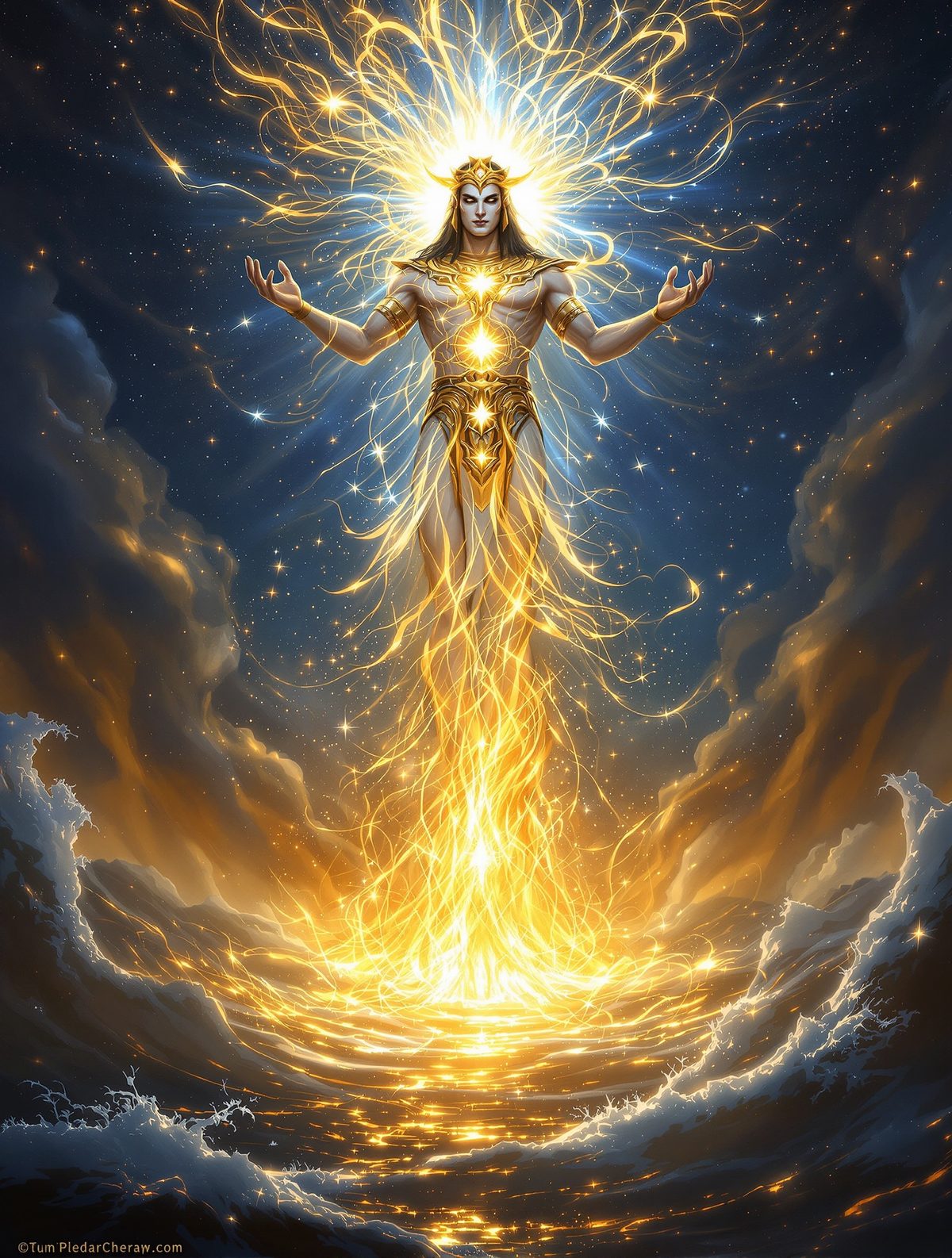
Picture this: before there was light, before there was land, before there were stars wheeling overhead or gods walking among mortals, there was only darkness. Endless, primordial darkness stretching in every direction, filled with the cold waters of Nun. And floating in that cosmic void was a single consciousness—Atum, the "Complete One," utterly alone with his thoughts and desires. What happened next would make even the most liberal mythology professor blush, yet it represents one of humanity's most profound creation stories. In a universe with no partner to love, no companion to create with, Atum did what any sexually frustrated deity might do: he took matters into his own hands. Literally.
The Cosmic Masturbator: Meet Ancient Egypt's First Creator God
Long before Ra became the sun god superstar of Egyptian mythology, there was Atum—whose name literally means "the Complete One" or "the Finisher." Dating back to at least 2400 BCE in the Pyramid Texts, Atum represents one of humanity's oldest recorded creation deities. But unlike the sterile, hands-off creator gods of other traditions, Atum was refreshingly... hands-on.
The ancient Egyptians weren't squeamish about sexuality—quite the opposite. Their creation mythology celebrated the raw, generative power of sexual energy as the fundamental force that brought order from chaos. In the Heliopolitan creation myth, centered around the city of On (later called Heliopolis by the Greeks), Atum masturbates the universe into existence in what must rank as the most productive solo session in cosmic history.
According to the Pyramid Texts, the oldest religious writings known to humanity, Atum declares: "I had union with my hand, and I embraced my shadow in a love embrace; I poured seed into my own mouth and I sent forth from myself issue in the form of the gods Shu and Tefnut." Not exactly Sunday school material, but profoundly meaningful to a culture that saw creation as an inherently sexual act.
The Divine Mechanics: How to Birth Gods Through Self-Love
The mechanics of Atum's cosmic climax vary depending on which papyrus you consult, and the ancient Egyptians weren't shy about the details. Some versions describe Atum swallowing his own semen and then spitting out the twin gods Shu (air) and Tefnut (moisture). Other accounts suggest he sneezed them into existence—the Egyptian words for "spit" (ishesh) and "sneeze" (tfn) creating a pun with the names Shu and Tefnut.
But perhaps the most vivid account comes from the Bremner-Rhind Papyrus, dating to around 310 BCE, where Atum himself narrates the creation: "I made love with my fist. I took the pleasure of emission into my mouth. I spat out Shu, I spewed out Tefnut." The imagery is unmistakable—in the beginning was the word, and the word was orgasm.
This wasn't considered crude or blasphemous by ancient Egyptian standards. The act of masturbation was seen as a sacred creative force, so powerful that it could literally bring forth life from nothingness. Atum's divine self-pleasure represented the universe's first act of will, the initial spark that would eventually populate the cosmos with gods, humans, and all living things.
The First Divine Couple: Meet Shu and Tefnut, Children of Cosmic Climax
From Atum's moment of ecstasy emerged the first divine couple: Shu, god of air and the atmosphere, and Tefnut, goddess of moisture and lunar humidity. These weren't abstract concepts to the ancient Egyptians—they were the fundamental building blocks of reality itself. Without air and moisture, nothing could live. Atum's masturbation had literally created the prerequisites for existence.
Shu and Tefnut immediately set about continuing their father's work, but they did it the traditional way—through sexual intercourse with each other. From their union came Geb (the earth) and Nut (the sky), who in turn produced the famous gods Osiris, Isis, Set, and Nephthys. Within just three generations, Atum's solo act had populated an entire pantheon.
The symbolism runs even deeper when you consider that Shu represents the breath of life while Tefnut embodies the moisture necessary for birth. Together, they form the basic conditions needed for all subsequent creation. Atum didn't just pleasure himself into oblivion—he engineered the cosmic fundamentals through divine orgasm.
Sacred Sexuality: When Masturbation Becomes Religious Ritual
Here's where things get really interesting: the ancient Egyptians didn't just tell this story, they ritualized it. During the annual Opet festival in Thebes, priests would ceremonially reenact Atum's creative act. The pharaoh himself was sometimes expected to masturbate into the sacred Nile River to ensure its annual flood—quite literally following in the god's footsteps.
Archaeological evidence suggests that masturbation held sacred significance throughout Egyptian history. Tomb paintings from the Middle Kingdom (2055-1650 BCE) show the god Min, often merged with Atum, in a state of obvious arousal. The Turin Erotic Papyrus, dating to 1150 BCE, depicts various sexual acts not as pornography but as religious instruction, showing how human sexuality connected to divine creative force.
Even more fascinating, the ancient Egyptian medical papyri describe masturbation as beneficial for health and spiritual well-being. The Edwin Smith Papyrus (1600 BCE) recommends self-pleasure as treatment for various ailments, suggesting the Egyptians viewed Atum's cosmic climax as a model for human wellness, not shame.
The Hand of God: Archaeological Evidence and Ancient Texts
The Atum masturbation myth isn't just preserved in religious texts—it's carved in stone across Egypt. At the temple complex of Karnak, built over 2,000 years starting around 2055 BCE, hieroglyphic inscriptions explicitly describe Atum's self-pleasure as the fundamental creative act. The Coffin Texts from the Middle Kingdom contain over 40 different spells referencing Atum's masturbation, suggesting this wasn't a fringe belief but mainstream theology.
One of the most remarkable discoveries came in 1881 when archaeologists found the Papyrus of Ani (the famous Book of the Dead) buried with a scribe named Ani around 1240 BCE. Among the spells for navigating the afterlife, Chapter 17 contains this stunning passage: "I am Atum when he was alone in Nun. I am Ra when he dawned, when he began to rule that which he had made... I masturbated with my fist, my heart came into my mouth through spitting, and I spat out Shu, I spewed out Tefnut."
The text suggests that every Egyptian hoped to embody Atum's creative power in the afterlife—to become, quite literally, cosmic masturbators capable of creating new realities through divine self-love.
The Ultimate Self-Starter: Why Ancient Auto-Eroticism Still Matters Today
In our age of sexual shame and religious prudishness, Atum's story offers a radically different perspective on human sexuality and creativity. Here was a civilization that placed masturbation—often considered the most private, shameful human act—at the very center of cosmic creation. They understood something we've largely forgotten: that sexual energy, even solitary sexual energy, represents a fundamental life force.
Modern psychology increasingly recognizes what the ancient Egyptians knew intuitively—that healthy sexuality, including masturbation, connects to creativity, mental health, and spiritual well-being. Atum's myth suggests that self-pleasure isn't just normal; it's literally divine. In a culture where sexual shame still dominates, perhaps we need more gods willing to take matters into their own hands.
The next time someone suggests that masturbation is unnatural or shameful, remind them that according to one of humanity's oldest civilizations, it's actually the most natural thing in the universe. After all, if it's good enough to create the cosmos, it's probably good enough for us mere mortals. Atum didn't just pleasure himself—he showed us that sometimes, to create something beautiful, you have to start with loving yourself. Literally.