
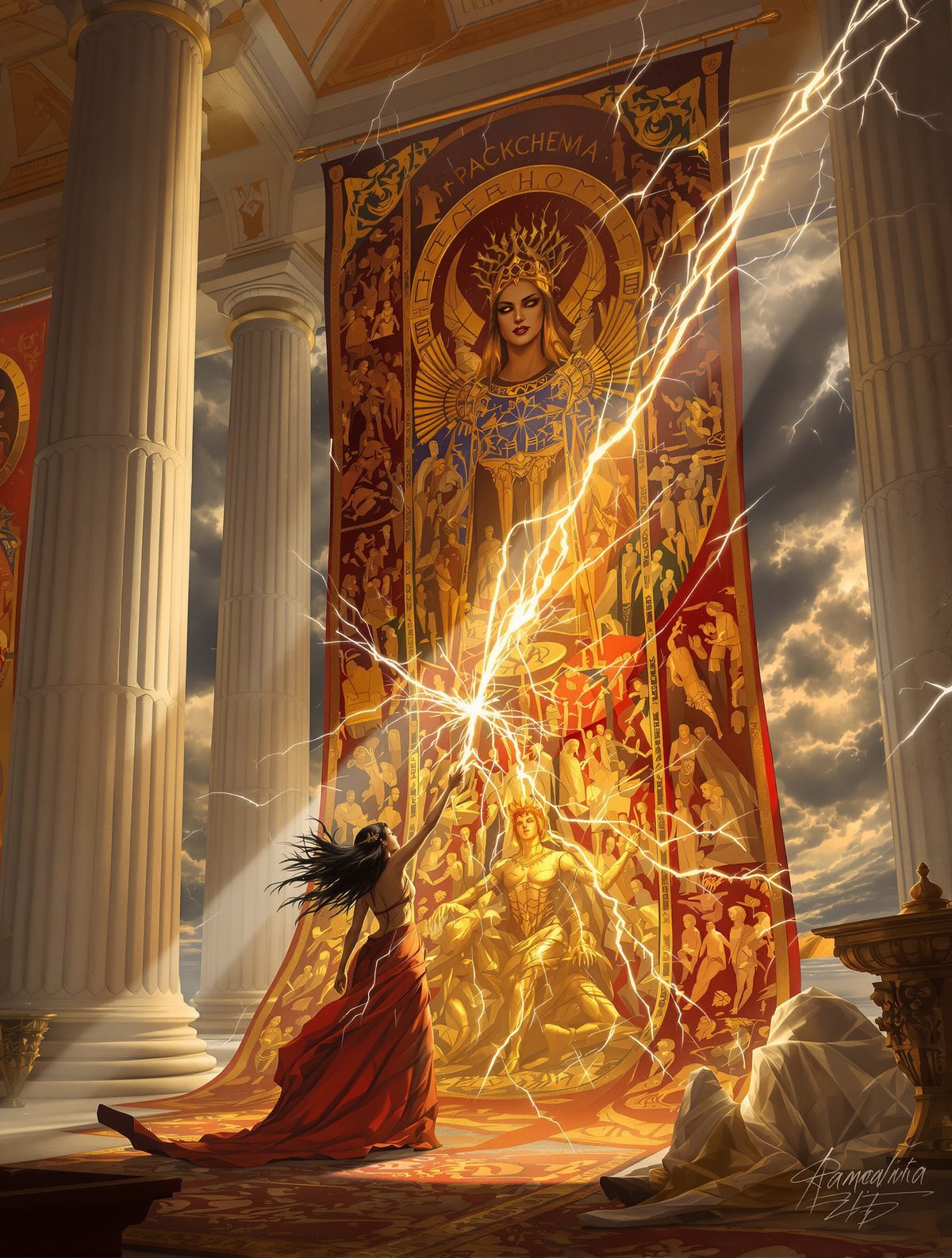
Floating between the threads of myth and the fibers of history is a tale that spins a web as captivating as the weaver herself. Arachne, a mortal girl from the ancient kingdom of Lydia, dared to challenge not just any god, but Athena, the divine patroness of wisdom and craft. Her crime? Weaving perfection. The legacy she left? A tragedy and an honor woven into every thread of our understanding of hubris and creativity.
The Loom in Lydia
Lydia, a region in what is modern-day Turkey, was known for its exquisite textile artistry. It was here, in the shadow of the towering Mount Tmolus and along the banks of the golden-maned river Pactolus, where Arachne honed her craft. Her fingers, stained with the colors of dyed wool and thread, danced across the loom with a grace that defied her mortal status.
Arachne’s tapestries were renowned not just in Lydia but across the Hellenic world. Her reputation was such that people would travel far and wide to witness her skillful hands as they wove life into fabric. But there was something more in those tapestries – a spark of irreverence that whispered through the threads, a challenge that resonated in every captured scene. Her bold renditions of mythos were not only an affront to artistic tradition but, eventually, a dare hurled toward Olympus itself.
The Challenge of a Lifetime
Whispers of Arachne's talent reached the ears of Athena, the goddess whose very domains included the art of weaving. Athena, also known as Minerva in Roman tradition, was not just skilled – she was said to have invented weaving. To hear of a mortal whose artistry was held in greater esteem than her own surely struck a chord with the goddess of wisdom and war.
This led Arachne to perhaps her most audacious act: a direct challenge to Athena. Arachne was not content with mortal accolades. She sought divine acknowledgment and, driven by a reckless blend of pride and ambition, invited Athena to a contest. In a remarkable act of hubris, Arachne boasted that her skills were equal, if not superior, to those of the divine weaver.
It was this invitation and the promise of a contest upon which Arachne staked her reputation, a move that the citizens of Lydia watched with bated breath. Arachne defiantly stood undaunted by the Olympian’s prowess, and the stage was set for a confrontation that would echo through the ages.
The Tapestry of Truths
In a secluded grove, beneath the watchful eyes of nymphs and dryads who dared peek at this unfolding celestial drama, two looms were set side by side. Athena, under the guise of a crone, revealed her divine form at Arachne’s unyielding insistence. Determined to prove her point, Arachne wasted no time in setting her shuttle to flight across the warps of her loom.
Under Arachne's deft touch bloomed a vision that captured every eye. The tapestry was a masterpiece of audacity – it depicted scenes of the gods at their worst. Zeus wielding his thunderbolt to seduce unsuspecting mortals, Poseidon pursuing demure nymphs, and other acts of divine indiscretion. Every thread was a razor-sharp indictment of the gods’ many indiscretions, woven with such skill it could not be denied nor undone. In contrast, Athena wove tales of her victories and the majestic gods in their resplendent glory.
Arachne’s work was described as flawless, both in technique and in its moving storytelling. Yet, it was the subject matter—a flagrant accusation against the gods’ failings—that drew Athena's ire more than any other aspect. As the stories sprang to vivid life beneath Arachne’s deft weave, a silent, palpable tension rippled through the air.
The Wrath of Athena
Athena, at first silent, gazed upon Arachne’s tapestry with eyes that saw more than detail and craft but the absolute truth she dared present. The goddess’s pride was wounded, her divine ego bruised by the mortal who suggested the gods were, in their way, as flawed as humans. In a fit of rage, Athena ripped the tapestry apart, tearing down the damning narratives that defied her supremacy.
But Athena’s retribution did not stop there. As Arachne stood, aghast at her demolished creation, the goddess pointed her finger in divine condemnation. Arachne’s body twisted, her limbs shrank, and she transformed into a creature destined to weave for eternity—a spider. Thus, Arachne became the progenitor of all arachnids, her artistry immortalized in every web spun by her countless descendants, each intricate pattern a ghost of her skill.
The Legacy of Arachne
Though the tale of Arachne is embedded in the fabric of Greek mythology, it serves as a powerful lesson on the complex interplay between creativity, honor, and hubris. On one hand, it cautions against the dangers of challenging the divine, but on the other, it celebrates the indomitable spirit of artistry, pushing boundaries even at great cost.
What makes the legend of Arachne resonate today is its timeless commentary on the freedoms of expression and the consequences of speaking inconvenient truths to power. In an era where challenging conventions can result in real-world repercussions, Arachne’s story continues to inspire artists and thinkers to weave their own narratives despite, or perhaps because of, potential backlash.
So, while Arachne’s form may have been shattered, her legacy is woven into the very concepts of creativity and defiance. In every fiber of courage and thread of innovation, we find traces of her – the weaver who dared shame the gods with nothing more than her perfect tapestry.