In the shadowy intersections of myth and history, sits a story so electrifying, so monumental, that its omission from textbooks echoes louder than thunder. Few tales are as harrowing as the day when even the mighty Zeus, king of the gods of Olympus, was made to scatter like a mere mortal. This is the account of Typhon's Siege—when the world's most fearsome creature, Typhon, unleashed chaos that left even the divine trembling, and mighty Zeus broken.
The Birth of a Monster
The large, tumultuous family of Greek myth gives birth to legends both awe-inspiring and terrifying. Typhon’s narrative is woven from the threads of revenge. Born of Gaia, the Earth Mother, and Tartarus, the deepest abyss of the underworld, he was crafted to be the ultimate nemesis to the gods who lived in arrogance atop their celestial thrones. Historically placed in an era lost to time, Typhon's story could be imagined to resonate around 1000 BCE, bringing forth a creature whose enormity and power still reverberate in today's cultural consciousness.
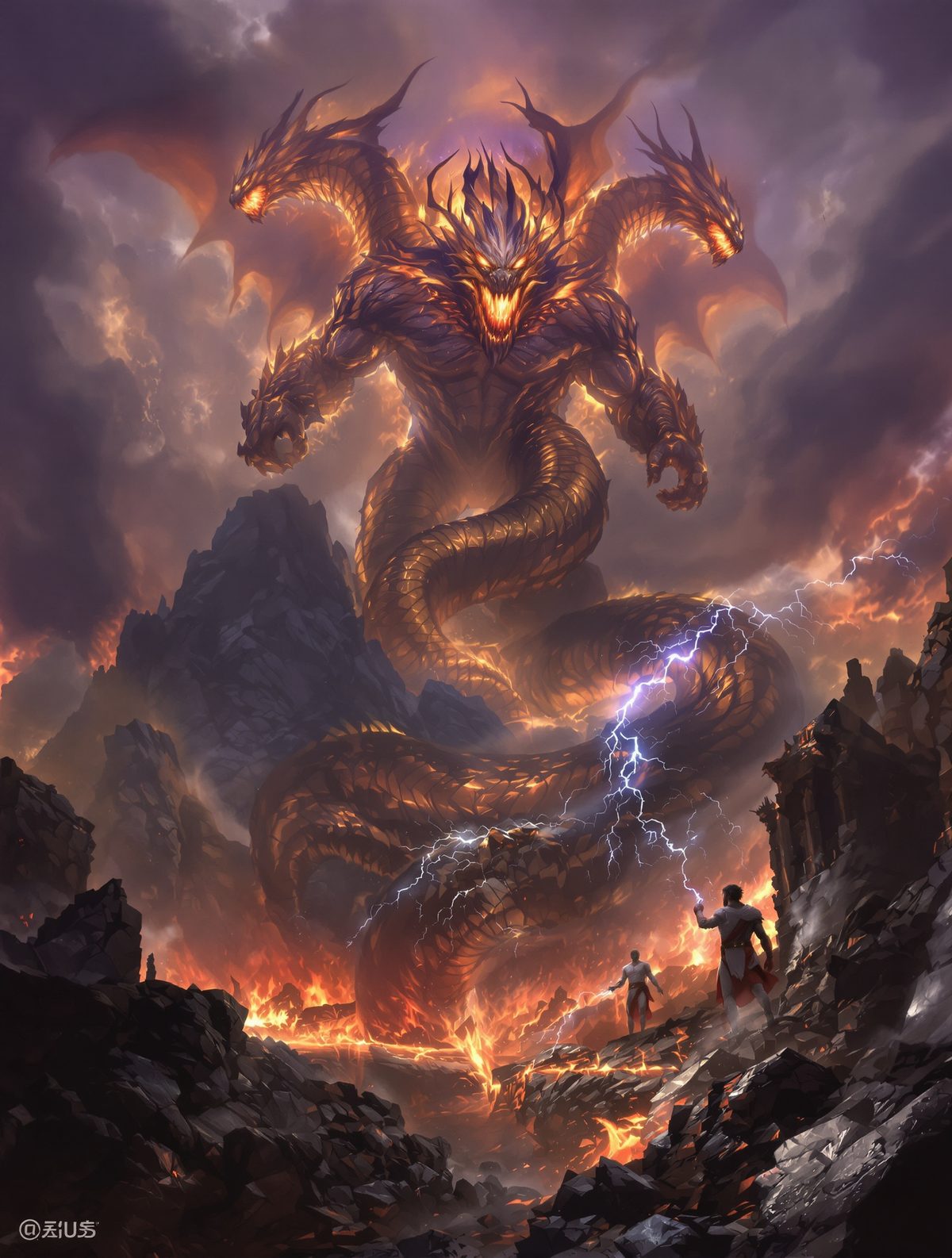
With his head nearly scraping the very sky and a hundred dragon heads rising from his shoulders, Typhon's presence was capable of blotting out the sun. Each head spoke with a different monstrous voice, capable of speech, music, or beastly roars. This cacophony underlined his nature as chaos incarnate—a retribution against Zeus, who had imprisoned Gaia's children, the Titans, in the grueling depths of Tartarus.
By Earth and Sky: The Prophecy Fulfilled
Gaia's vengeance was not rooted in mere malice. It was a mother’s furious love fuelled by the pain of a cosmos divided by her own progeny’s ambition. As Gaia gave birth to her last masterpiece, the ancient oracles whispered fears of Typhon across a Greece that revered and dreaded their prophecies. It was foretold that he would rise against the stern law of Olympus, instilling dread in the immortal heart of Zeus himself.
Little known is the fact that even the Titans, once enemies of Olympus, looked upon Typhon with cautious respect—perhaps, somewhere within, sensing the unavoidable lineage that bound them to this chaos-bringer. Under Typhon's raw power, old stories suggest the very sea churned without wind, and mountains trembled under a sky painted with fire.
The Day Olympus Trembled
The climactic encounter between Typhon and Zeus is set against the backdrop of Mount Olympus, a stage for divine battles and high drama. One might imagine this fateful day—the sky darkened as Typhon emerged, his presence cast across every corner of the known world. The stronghold of Olympus, representing celestial order, was now vulnerable to a being whose purpose was pure, unfiltered disorder.
Zeus, wielding his invincible thunderbolts, confronted this embodiment of chaos. But Typhon was no mere adversary. In their clash, the air filled with sound so loud it silenced the earth. Typhon, unyielding, managed the unthinkable: he reached out with his serpentine limbs, seized Zeus, and effortlessly stripped him of his sinewy power, rendering him motionless, broken, clutching only the dust of Olympus beneath him. Even the sky refused to weep, locked in stunned silence.
Gods in Exile: The Flight to Egypt
With their leader compromised, the gods of Olympus succumbed to dread unlike anything they had faced before. They fled, assuming the guise of animals as they crossed the Greek landscapes and seas, seeking refuge in none other than Egypt—a land rich with its own ancient mystique and deities.
Historical footnotes often skip this episode of Greek deities masquerading as Egyptian gods; for example, Apollo is said to have transformed into a hawk, while Artemis took the form of a cat. This cross-cultural exchange of gods not only highlights a fascinating interplay between Greek and Egyptian religious traditions but also speaks volumes about the lengths to which even immortals would go to ensure survival.
The Divine Retribution
Zeus, though wounded and discarded, was far from defeated. Stories stitched into the fabric of ancient Greece tell us how Zeus, through cunning and resilience, managed to retrieve his severed sinews, often attributed to the help of Hermes and Aegipan. A masterpiece of healing from Apollo was also invoked in some versions, restoring the thunderer to his former glory.
The final showdown between Typhon and the restored Zeus echoed through the ages—thunder battled flame, and ultimately, through sheer will and reformulated strategy, Zeus triumphed. With one last almighty thunderbolt, he buried Typhon beneath Mount Etna, an epic conclusion to an unforgettable siege that forever portrayed Zeus as both fallible and formidable.
The Legacy of Typhon's Siege
Why does Typhon’s siege, a mythic tale submerged in antiquity, matter today? Beyond the fantastical, it serves as a narrative metaphor for resilience and the inherent struggle between order and chaos within us all. The tale of Zeus's fleeing Olympus only to reclaim his throne is a reminder of vulnerability—a poignant truth that even the mightiest encounter challenges beyond strength, requiring adaptability and determination.
As we navigate the complex tapestry of our own lives, filled with unforeseen 'Typhons', the story teaches us that the measure of power is not only in the might but in the wisdom of recovery and the art of the comeback. This ancient legend left out of the textbooks persists as a testament to overcoming insurmountable odds, resonating with every fall and rise scripted into the human experience.