
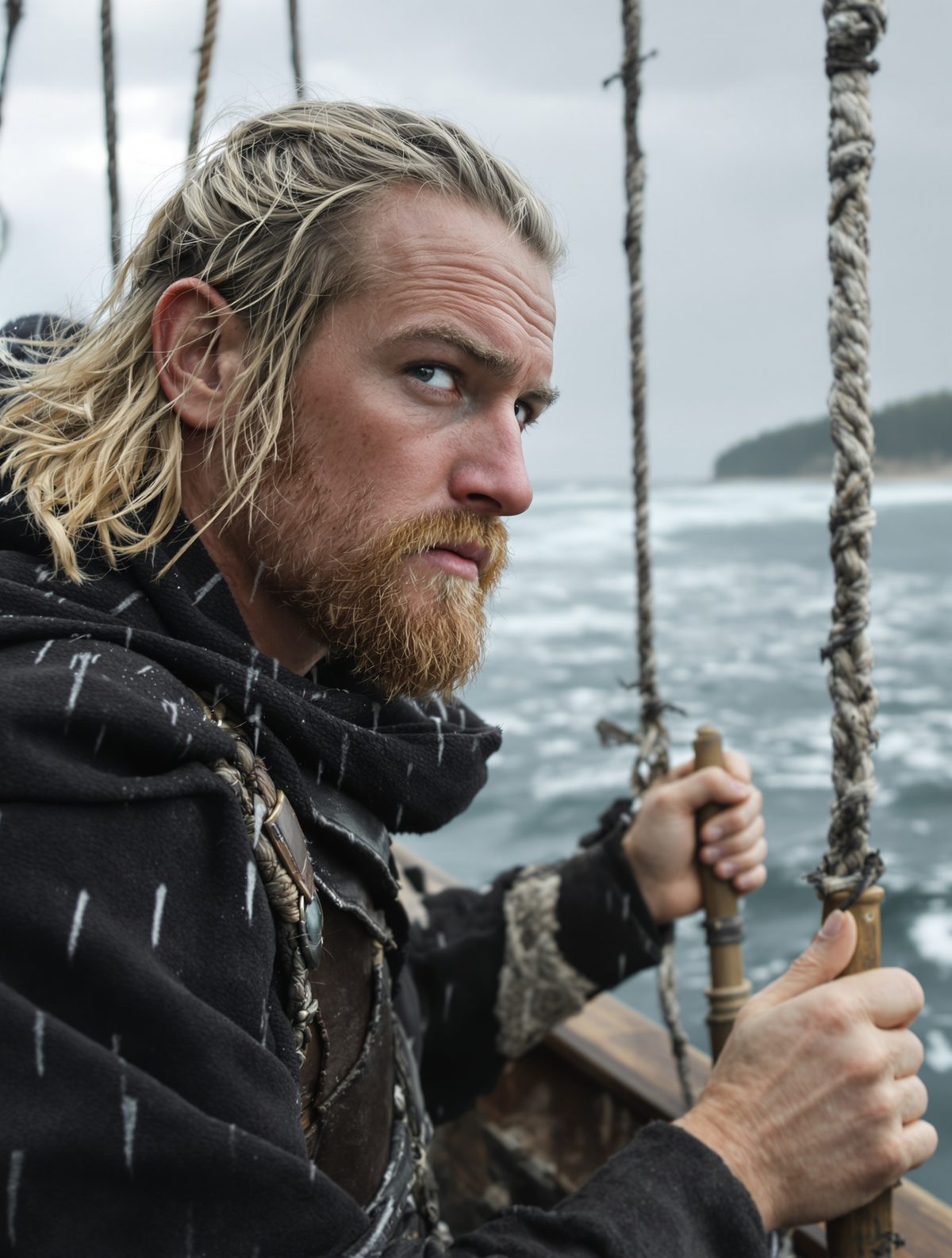
Picture this: a young Viking merchant desperately scanning the horizon through sheets of rain and spray, his wooden ship groaning under the assault of North Atlantic gales. For days, Bjarni Herjólfsson has been lost in waters no Norseman has ever charted. When the storm finally breaks and he glimpses a strange, forested coastline stretching endlessly to the south, he makes a decision that will echo through history—he turns his ship around and sails away. In that moment of maritime caution, Bjarni becomes the first European to lay eyes on North America, yet he'll never set foot on the continent that would later reshape the world.
A Son's Journey Gone Wrong
The year was 986 AD, and twenty-something Bjarni Herjólfsson was riding high on the success of his merchant ventures across the North Sea. Based in Iceland, he'd built a reputation as a skilled navigator and shrewd trader, but there was one tradition he held more sacred than profit: spending every winter with his father, Herjólf Bárðarson. But when Bjarni returned to Iceland that autumn, his father's farmstead stood empty.
The locals delivered stunning news—Herjólf had joined Erik the Red's colonization expedition to a mysterious land called Greenland. This wasn't just any casual relocation. Erik the Red, fresh off his own exile from Iceland for manslaughter, had spent three years exploring this new territory and returned with tales of green valleys and promising pastures. In 985 AD, he'd convinced nearly 1,000 Icelanders to abandon their homes and join his grand experiment in Arctic colonization.
For Bjarni, this presented an unprecedented challenge. No merchant vessel had yet made the journey to Erik's new settlements. He possessed no maps, no established routes, no landmarks to guide him across 450 miles of treacherous North Atlantic waters. His crew thought he was mad. "It's unwise to sail into the Greenland Sea without knowledge of it," they warned him, according to the Grœnlendinga saga. But Bjarni was determined. "We'll share whatever fate awaits us," he declared, and set sail into the unknown.
When the Sea Gods Intervene
What happened next reads like something from Norse mythology, except the consequences were startlingly real. For three days, favorable winds pushed Bjarni's ship northwest toward Greenland. Then the weather turned vicious. North winds and fog descended like a curse, shrouding the vessel in an impenetrable gray cocoon. For days—the sagas don't specify exactly how many, adding to the mystery—Bjarni and his crew sailed blind through churning seas.
Imagine the terror: no GPS, no compass, no way to determine position except by sun and stars that remained hidden behind thick cloud cover. The Vikings navigated by reading wind patterns, ocean swells, and the flight of seabirds. Stripped of these natural compasses, Bjarni was flying blind across one of the world's most dangerous seas. His ship, likely a knörr—a sturdy cargo vessel about 50 feet long—was built for trade, not exploration. Every day lost at sea meant dwindling food supplies and growing desperation.
When the weather finally cleared and the sun broke through, Bjarni took his bearings and realized something was terribly wrong. The landscape before him bore no resemblance to the Greenland his father's letters had described. Instead of towering glaciers and rugged mountains, he saw "a land that was not mountainous, but well-wooded and with low hills."
The Shores of Vinland
What Bjarni was seeing, though he couldn't know it, was the coast of North America—most likely somewhere along what we now call Labrador or Newfoundland. He had achieved something no European had ever done: crossed the Atlantic and reached the New World. Yet his reaction was not wonder or curiosity, but frustration and practical concern.
His crew wanted to investigate. After days of terror at sea, the sight of solid ground must have seemed like salvation. But Bjarni proved to be a cautious commander. "This doesn't match the description of Greenland," he observed with masterful understatement. More importantly, he was a merchant on a mission, not an explorer seeking glory. His ship was loaded with trade goods meant for his father, and winter was approaching. In the sub-Arctic, being caught in unfamiliar territory when the weather turned could mean death.
So Bjarni made a decision that modern adventurers might find incomprehensible: he ordered his crew to stay aboard and sailed parallel to the mysterious coastline, taking careful mental notes but never landing. The saga records his methodical observations as they sailed north: "They sailed for two days and saw a second land. This was flat and wooded." Still not Greenland. They continued north and "saw a third land, and this one was high and mountainous and topped with a glacier."
Here's where the story gets almost comically frustrating for his crew. Even this glaciated landscape didn't match Greenland's description perfectly, so Bjarni still refused to land. His men were practically begging to go ashore—they needed fresh water and supplies—but their captain remained unmoved. "You lack for nothing," he told them with the confidence of a man who'd clearly never been truly lost at sea.
The Return to Civilization
Finally, after what must have felt like an eternity, Bjarni spotted familiar landmarks and reached the Greenland coast. Four days later, he arrived at his father's new settlement in Herjólfsnes (modern-day Cape Farewell). The reunion was joyful, but Bjarni's story of mysterious western lands created a sensation throughout the small Norse community.
Here's a detail that reveals the medieval mindset: rather than being celebrated as a great discoverer, Bjarni faced criticism for his cautious approach. The saga notes that "Bjarni was thought to lack curiosity, since he had nothing to tell about these lands, and he faced some reproach for this." In Norse culture, bold exploration and the ability to tell compelling stories about your adventures were highly valued. By modern standards, Bjarni had made the discovery of the millennium, but his contemporaries saw him as a man who'd failed to properly investigate something interesting.
This social pressure reveals something fascinating about Viking culture. These weren't just raiders and pillagers, but a society that valued knowledge, exploration, and good storytelling. Bjarni's practical, cautious approach—while probably saving his crew's lives—didn't fit the heroic ideal his peers expected.
The Spark That Lit Leif's Fire
For fourteen years, Bjarni's story circulated through the small world of Norse Greenland like a persistent itch that couldn't be scratched. Every feast, every gathering, someone would bring up those mysterious wooded shores to the west. The tale eventually reached the ears of Leif Erikson, son of Erik the Red himself, and it captivated his imagination in a way it never had Bjarni's.
Around 1000 AD, Leif decided to finish what Bjarni had started. In a move that shows the interconnected nature of Viking society, Leif actually bought Bjarni's ship—the same vessel that had first sighted America—and recruited a crew of thirty-five men for a proper expedition. Using Bjarni's descriptions as a guide, Leif retraced the accidental route in reverse, systematically exploring each land Bjarni had glimpsed.
The results were spectacular. Leif landed at three distinct locations, which he named Helluland ("Flat Stone Land," likely Baffin Island), Markland ("Forest Land," probably Labrador), and finally Vinland ("Wine Land," somewhere in Newfoundland or beyond). At Vinland, Leif established the first European settlement in North America, complete with large houses and workshops—five centuries before Columbus was born.
Archaeological evidence at L'Anse aux Meadows in Newfoundland confirms the Norse presence, with radiocarbon dating placing the settlement around 1000 AD. Artifacts include iron nails, a bronze pin, and worked wood—unmistakable proof that Europeans lived in North America during the medieval period.
The Accident That Changed History
Bjarni Herjólfsson's story forces us to reconsider how historical discovery actually works. We often imagine great moments of exploration as the result of bold vision and careful planning—Columbus seeking a western route to Asia, or Lewis and Clark mapping the American frontier. But sometimes the most consequential discoveries happen by pure accident, made by people who don't even realize the magnitude of what they've found.
If Bjarni had been a different kind of man—more curious, less focused on his merchant mission—European colonization of the Americas might have begun in 1000 AD rather than 1500 AD. The entire trajectory of world history could have been different: no Aztec or Inca empires at their peak when Europeans arrived, no massive demographic catastrophe from Old World diseases, perhaps a more gradual and less devastating cultural collision between continents.
Instead, Bjarni's accidental discovery remained confined to the small Norse settlements of Greenland and Iceland. When those communities eventually failed—Greenland's last Norse settlement disappeared around 1450 AD—the knowledge of Vinland disappeared with them. Columbus would sail west in 1492 with no idea that Europeans had already reached America five centuries earlier.
In our age of satellite mapping and instant global communication, it's hard to imagine discoveries simply being forgotten. But Bjarni's story reminds us how fragile human knowledge really is, and how often the most important moments in history happen not to heroes seeking glory, but to ordinary people just trying to get home.