
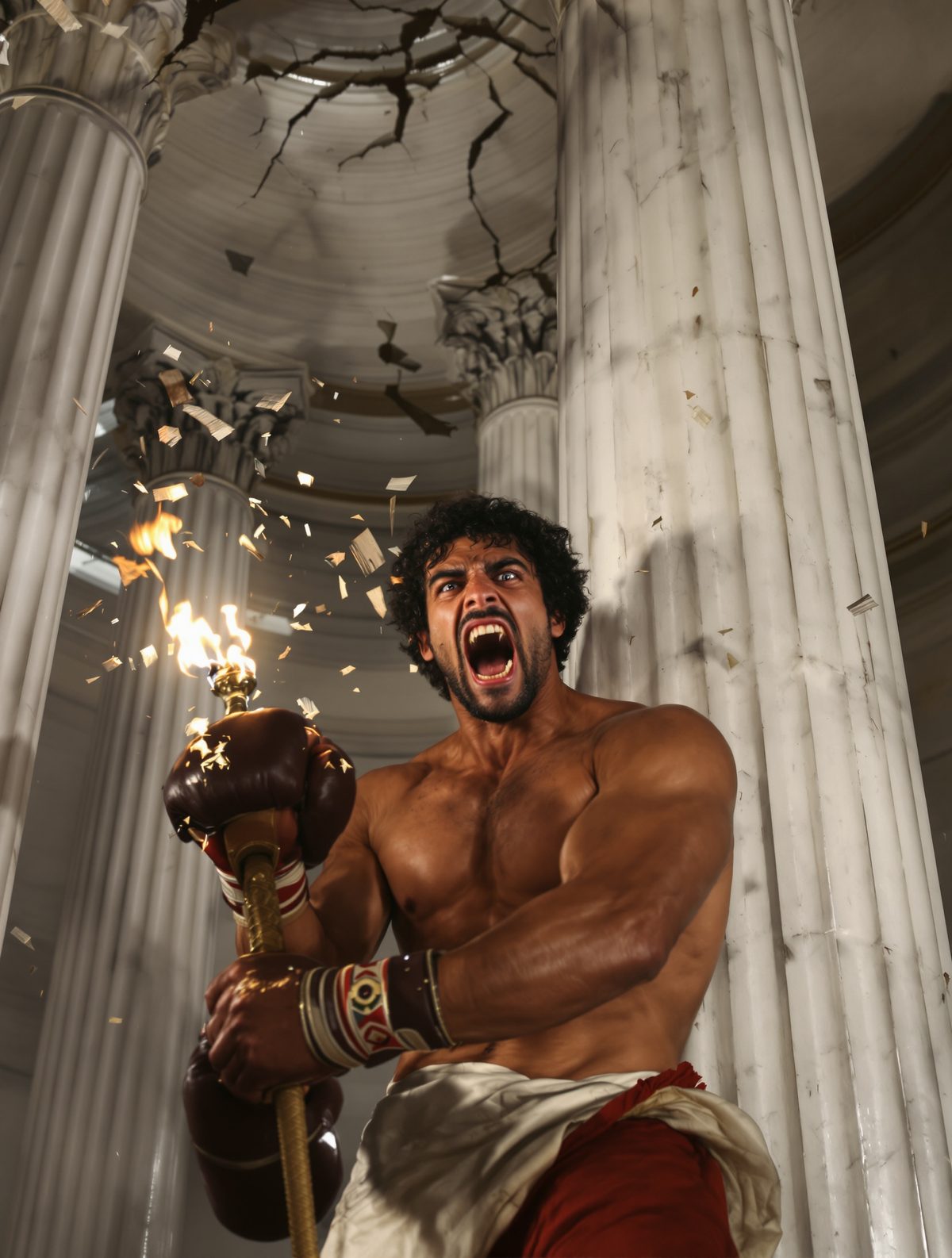
The sacred silence of the Temple of Athena was shattered by the thunderous crash of collapsing marble and timber. Dust clouds billowed through the ancient corridors as screams pierced the air. When the debris finally settled in 492 BC, sixty children lay crushed beneath the rubble, their young lives extinguished in an instant of unimaginable violence. At the center of this carnage stood a man who had once been celebrated as the greatest boxer in all of Greece—now transformed into something far more terrifying.
This is the story of Kleomedes of Astypalaia, whose name has echoed through history not as an Olympic champion, but as a cautionary tale of pride, rage, and the thin line between heroism and monstrosity.
The Sweet Science of Ancient Brutality
To understand Kleomedes' fall from grace, we must first step into the blood-soaked sands of ancient Olympic boxing. This wasn't the gentleman's sport of modern times—it was a savage display of human endurance that would make today's mixed martial arts look like a tea party. Boxers wrapped their hands in himantes, leather straps that hardened over time into weapons capable of shattering bone and splitting flesh.
There were no weight classes, no rounds, and certainly no referee to step in when things got ugly. Fighters battled until one man either fell unconscious, raised his hand in surrender, or simply died. The only rules were simple: no holding, no hitting below the belt, and absolutely no striking a man who had fallen. Everything else was fair game.
Kleomedes had mastered this brutal art like few before him. Standing over six feet tall—a giant by ancient standards—he possessed the kind of crushing power that could end fights with a single blow. By the time he arrived at Olympia in 492 BC for the 72nd Olympic Games, he was already a legend whispered about in gymnasiums across the Mediterranean.
When Gods Watched Men Bleed
The Olympic Games of 492 BC drew over 40,000 spectators to the sacred valley of Olympia. They came from every corner of the Greek world—from the marble cities of Ionia to the warrior strongholds of Sparta—all united in their worship of athletic excellence. The boxing competition was scheduled for the fourth day of the five-day festival, and anticipation crackled through the crowd like lightning before a storm.
Kleomedes' opponent in the final was Ikkos of Epidaurus, a seasoned fighter known for his defensive brilliance and iron chin. What should have been a showcase of skill between two masters instead became a nightmare that would haunt Greek sports for generations.
The fight began at dawn, with both men trading thunderous blows under the watchful eyes of the Hellanodikai—the sacred judges who served as arbiters of Olympic justice. For hours, neither fighter could gain a decisive advantage. Kleomedes' power met Ikkos' technical superiority in a grinding war of attrition that left both men bloodied and exhausted.
Then, as the sun reached its zenith, something inside Kleomedes snapped. Perhaps it was the frustration of being unable to finish his opponent, or maybe the pressure of competing before the largest crowd he'd ever faced. Whatever the trigger, what happened next transformed him from celebrated athlete into cold-blooded killer.
The Blow That Changed Everything
Ancient sources describe the moment with chilling clarity. As Ikkos stumbled and began to fall, Kleomedes should have stopped fighting—it was both law and sacred tradition. Instead, he unleashed a devastating uppercut that caught his helpless opponent under the chin. The sound of Ikkos' neck snapping echoed across the stadium like a branch breaking in a storm.
The crowd fell silent. Even in an era when death in athletic competition was accepted as the price of glory, this was different. This was murder disguised as sport, and everyone knew it.
The Hellanodikai needed no deliberation. They stripped Kleomedes of his victory on the spot, declaring that he had committed phonos—unlawful killing—in the sacred precinct of Zeus himself. His name would not be inscribed on the victor's rolls, no olive crown would grace his head, and no hero's welcome awaited him at home. Instead, he was banished from Olympia in disgrace, transformed overnight from champion to pariah.
But the judges had made a crucial error. They had publicly humiliated a man whose entire identity was built on physical dominance and public adoration. They had created a monster, and that monster was heading home to the island of Astypalaia with nothing left to lose.
Sanctuary Becomes Slaughterhouse
The island of Astypalaia sits like a forgotten jewel in the Dodecanese, its rocky hills rising from wine-dark waters that have witnessed three millennia of human drama. When Kleomedes' ship arrived at the harbor, word of his disgrace had already spread. The man who had left as their greatest hero returned as their greatest shame.
Unable to face the stares and whispers, Kleomedes sought refuge in the one place where ancient Greek law guaranteed safety: the Temple of Athena. This wasn't unusual—temples served as sanctuaries where even the worst criminals could claim divine protection. What was unusual was what Kleomedes planned to do once he got there.
The temple school was in session when he arrived. Sixty children, the sons and daughters of Astypalaia's leading families, were receiving their daily lessons in reading, writing, and mathematics. These were the island's future leaders, its brightest hopes for the next generation. They were also about to become the victims of one man's unhinged rage.
When the angry crowd finally tracked Kleomedes to the temple and demanded he face justice for his crimes at Olympia, he made a choice that defied all logic and humanity. Rather than surrender, he grabbed hold of the massive wooden beam that supported the temple's roof—a beam that would have required multiple men to move under normal circumstances.
What happened next was witnessed by hundreds but believed by few. With a roar that seemed to shake the very foundations of the earth, Kleomedes pulled the beam free. The entire roof came crashing down, crushing everyone inside in a cascade of marble, timber, and stone.
The Birth of a Dark God
When rescue workers finally cleared the rubble, they found the bodies of all sixty children. But Kleomedes himself had vanished without a trace. No body, no blood, no sign he had ever been there at all. It was as if the earth itself had swallowed him whole.
The mystery deepened when Astypalaia sent envoys to consult the Oracle at Delphi, desperate to understand what had happened in their sacred temple. The Pythia's response was as shocking as it was inexplicable: "Kleomedes of Astypalaia is the last of the heroes. Honor him with sacrifices, for he is no longer mortal."
This divine pronouncement created a theological crisis that reverberated throughout the Greek world. How could a child-killer be declared a hero? How could a man who committed sacrilege in a sacred temple be worthy of divine honors? Yet the Oracle had spoken, and in ancient Greece, the word of the gods was absolute law.
The people of Astypalaia found themselves in an impossible position. They built a shrine to honor the man who had murdered their children, offering sacrifices to appease the spirit of their greatest monster. Archaeological evidence suggests this cult continued for centuries, a testament to the power of divine authority over human justice.
The Champion Who Became a Cautionary Tale
The story of Kleomedes forces us to confront uncomfortable truths about the nature of heroism, celebrity, and the price of unchecked power. Here was a man whose entire identity was built on physical dominance and public adulation—sound familiar? In our age of sports superstars and social media celebrities, the parallels are impossible to ignore.
What happens when someone whose entire sense of self is tied to public approval suddenly finds that approval stripped away? What happens when physical power meets psychological fragility? The ancient Greeks understood something we often forget: the line between hero and villain is thinner than we'd like to believe, and crossing it can happen in the space of a single, terrible moment.
Kleomedes' transformation from celebrated champion to divine monster serves as a stark reminder that greatness in one arena doesn't guarantee goodness in all others. His story survived for over two millennia not because the Greeks celebrated his actions, but because they recognized the dark potential that lurks within unchecked power and wounded pride. In honoring him as a hero while mourning his victims, they created one of history's most complex and troubling cautionary tales—one that speaks to our modern world with uncomfortable clarity.