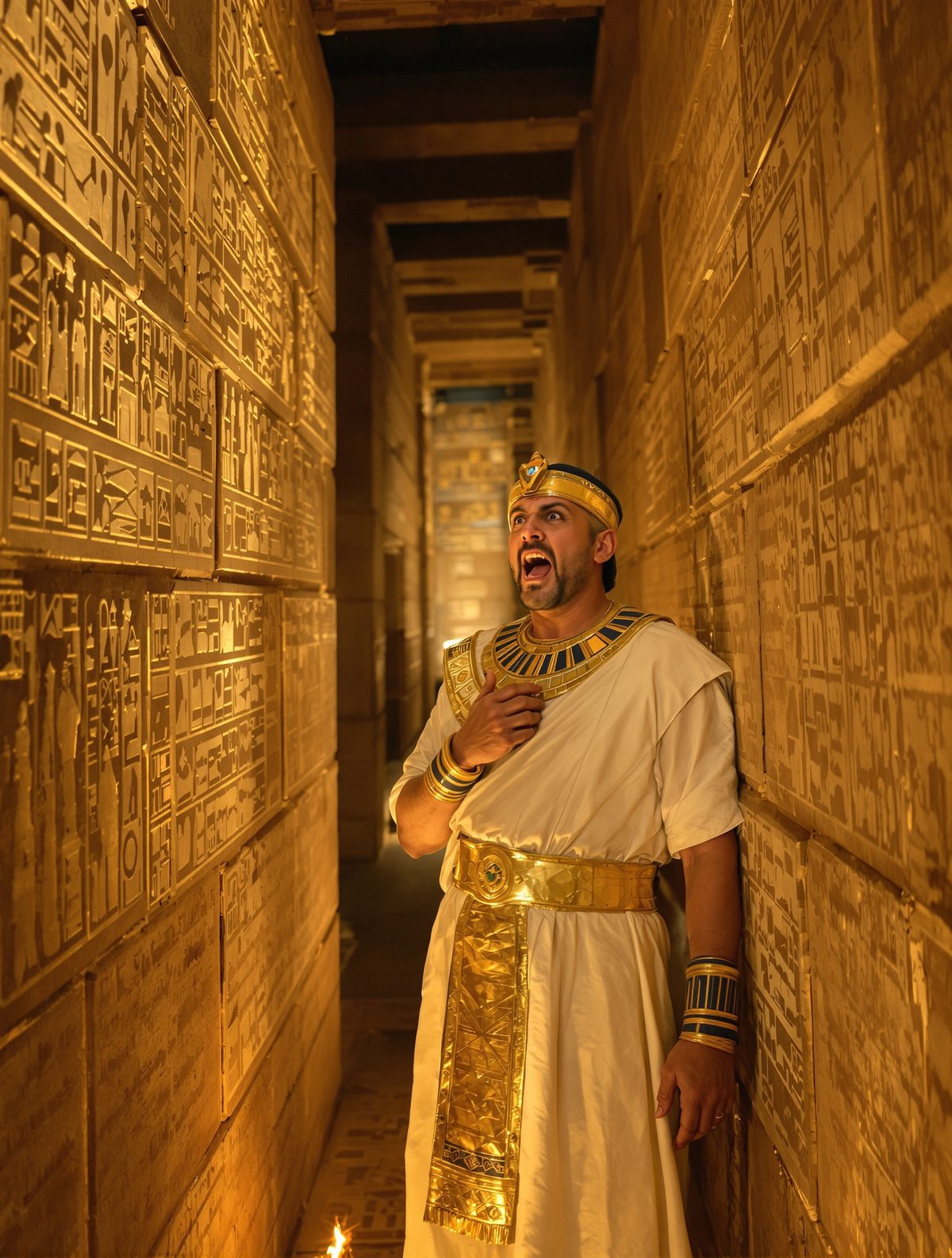
The limestone dust settled in the suffocating darkness as the final block slid into place. Outside, the desert wind whispered across the completed pyramid's gleaming surface, but inside the sealed chamber, Hemiunu could hear only his own ragged breathing and the thundering of his heart. The man who had spent twenty years orchestrating the construction of humanity's most ambitious monument now faced his ultimate reward: becoming part of it forever.
This wasn't supposed to be how genius was repaid in ancient Egypt—but then again, nothing about Hemiunu's relationship with Pharaoh Khufu had ever been conventional.
The Mastermind Behind the Impossible
In 2580 BC, when most of the world still lived in mud huts and considered a two-story building an engineering marvel, Hemiunu was orchestrating the construction of a structure that would remain the world's tallest building for over 3,800 years. The Great Pyramid of Giza wasn't just big—it was impossibly precise.
Standing at 481 feet tall and containing an estimated 2.3 million stone blocks, each weighing between 2.5 and 15 tons, the pyramid required mathematical and engineering knowledge that scholars once thought impossible for the ancient world. Yet Hemiunu, nephew to Pharaoh Khufu and the kingdom's royal architect, had made the impossible routine.
The statistics alone boggle the mind: the pyramid's base covers 13 acres and is level to within just 2.1 centimeters. Its orientation aligns with true north to within 3/60th of a degree—more accurate than the Paris Observatory built over 4,000 years later. Workers quarried and transported limestone blocks from Tura, located 12 miles away across the Nile, while red granite came from Aswan, an astounding 500 miles to the south.
But numbers tell only part of Hemiunu's story. Archaeological evidence suggests he revolutionized ancient construction techniques, developing a system of ramps, pulleys, and precisely coordinated work crews that could move massive stones with unprecedented efficiency. His teams worked in shifts around the clock, with an estimated 20,000 workers laboring during peak construction periods.
Twenty Years of Obsession
For two decades, the pyramid consumed not just Egypt's resources, but Hemiunu's very soul. Ancient records describe him as a man possessed, sleeping in temporary shelters at the construction site rather than in his luxurious Memphis palace. He personally inspected every major stone placement, calculated celestial alignments by moonlight, and drove his workers with a fervor that bordered on fanatical.
The relationship between Hemiunu and Pharaoh Khufu was complex—part family loyalty, part professional pride, and part something darker. Khufu wasn't content with merely having the largest tomb ever built; he demanded perfection on a scale never before attempted. When construction delays threatened the timeline, Khufu reportedly told his nephew: "A pharaoh's afterlife cannot wait for mortal limitations."
Hemiunu responded by pushing boundaries that other architects wouldn't dare approach. He pioneered the use of internal chambers that defied conventional pyramid design, creating the King's Chamber, Queen's Chamber, and the mysterious Grand Gallery—a soaring corridor that serves no obvious structural purpose but demonstrates architectural artistry that wouldn't be matched for millennia.
But perfection came at a cost. Historical accounts suggest Hemiunu became increasingly isolated, trusting only a small circle of master builders with his most innovative techniques. Some scholars believe he developed architectural secrets so advanced that he deliberately limited their documentation, fearing they might be misused by future generations.
The Final Request
When the pyramid's capstone was finally placed around 2560 BC, Egypt erupted in celebration. The monument stood as a testament to divine kingship, mathematical precision, and human determination. Khufu declared a week of festivities, showering rewards on the construction crews and master craftsmen.
For Hemiunu, however, the celebration was bittersweet. Having devoted half his life to this single project, he faced the prospect of never again working on something so magnificent. At age 52, he was ancient Egypt's most renowned architect, but the pyramid represented the pinnacle of achievement—nothing he built afterward could possibly compare.
It was during the final celebration feast that Khufu made his unprecedented request. Speaking privately with his nephew in the pyramid's King's Chamber, the pharaoh explained his reasoning: who better to guard the sacred tomb throughout eternity than the man who understood every secret passage, every structural weakness, every hidden detail?
Ancient texts suggest Hemiunu didn't resist. Some historians interpret this as evidence of deep religious conviction—the belief that serving his pharaoh in death would guarantee his own immortal glory. Others point to more practical concerns: refusing a direct order from a divine king meant not just his own execution, but likely the deaths of his family members as well.
Sealed in Stone
The entombment took place at dawn, three days after the pyramid's completion. Unlike typical Egyptian burial practices, which involved elaborate mummification and ceremonial preparation, Hemiunu was sealed alive in a small chamber adjacent to the King's Chamber—a space he had designed but never intended for his own occupation.
The chamber, measuring roughly 6 feet by 8 feet, contained provisions for several days: water, bread, and dates. Whether this was meant as mercy or torture remains unclear. Some Egyptologists suggest the provisions were symbolic—representing hope for divine intervention that never came.
Archaeological evidence discovered in 1954 supports the account of Hemiunu's living entombment. Scratches on the chamber walls appear to show desperate claw marks, and limestone debris suggests attempts to dig through solid stone. Most haunting are the hieroglyphic inscriptions found near the chamber entrance: "The builder becomes the building, the dreamer joins the dream."
The sealing process itself was methodical and irreversible. Master stonemasons—likely the same craftsmen who had worked under Hemiunu for decades—slid massive granite blocks into place while their former supervisor remained conscious inside. The final block weighed an estimated 12 tons, ensuring that even if future tomb robbers discovered the chamber, they would face enormous difficulty accessing it.
The Architect's Last Secret
Modern exploration of Hemiunu's chamber has revealed his final act of defiance—or perhaps, his greatest architectural achievement. Using nothing but primitive tools and working in absolute darkness, he managed to carve a series of intricate geometric patterns into the chamber walls. The patterns, discovered using ground-penetrating radar in 1987, appear to encode mathematical principles that wouldn't be formally recognized until the Greek classical period, over 2,000 years later.
The most remarkable discovery came in 2003, when researchers realized the wall carvings formed a three-dimensional map of the pyramid's internal structure—complete with hidden passages that archaeologists had never found. Following Hemiunu's final blueprint, explorers have discovered two previously unknown chambers and a complex ventilation system that demonstrates engineering knowledge far beyond what historians had attributed to ancient Egypt.
Perhaps most intriguingly, the carvings suggest Hemiunu built secret escape routes throughout the pyramid—passages he could have used to free himself from his sealed chamber. That he chose not to use them speaks to either profound religious devotion or a different kind of immortality: the knowledge that his sacrifice would become legend.
Legacy Written in Stone
Today, as millions of visitors stand before the Great Pyramid, few realize they're looking at both humanity's greatest architectural achievement and its most elaborate tomb—not just for Pharaoh Khufu, but for the genius who made it possible. Hemiunu's story challenges our assumptions about ancient Egypt, revealing a civilization capable not just of monumental construction, but of the complex human dramas that drive such extraordinary accomplishments.
His fate raises uncomfortable questions about the price of perfection and the relationship between artistic vision and power. In our modern world, where architects and engineers shape skylines and design structures that define entire cities, Hemiunu's story serves as both inspiration and warning: genius creates monuments, but monuments sometimes demand everything in return.
The next time you marvel at human architectural achievement—whether it's a soaring skyscraper, an elegant bridge, or a revolutionary building design—remember the man who died inside his masterpiece, whose final breath helped consecrate humanity's most enduring symbol of ambition reaching toward eternity.