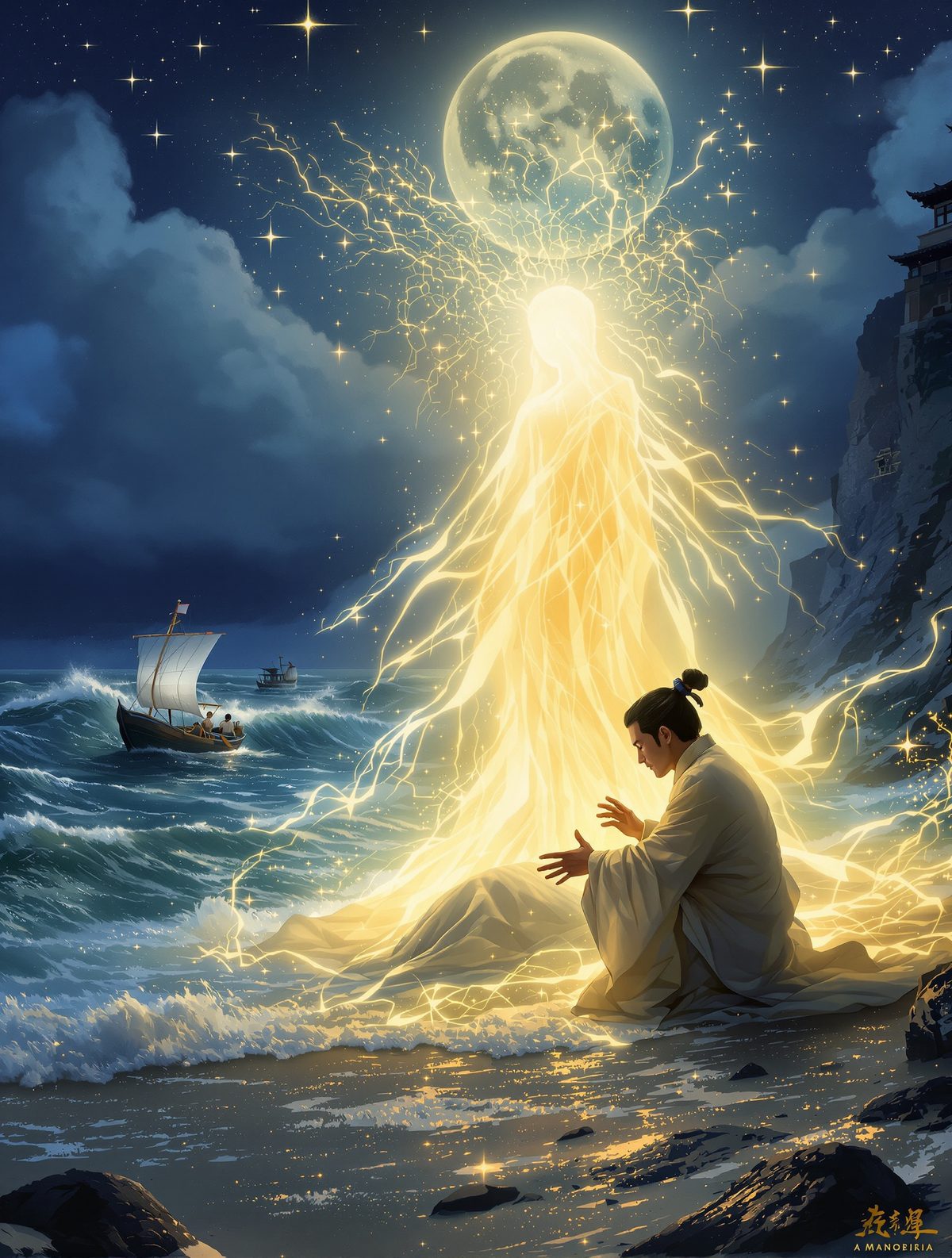
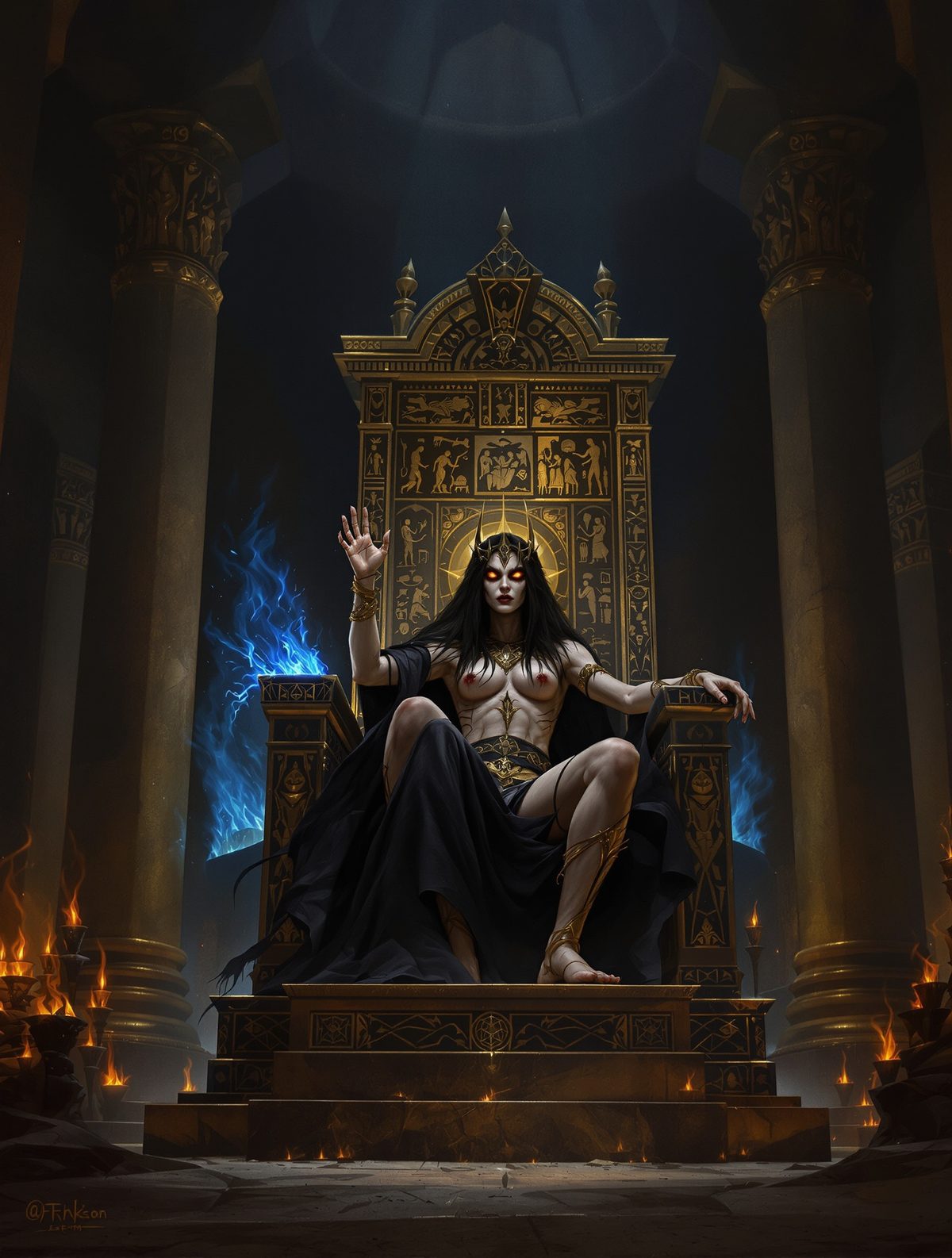
Picture this: the most powerful goddess in all of Mesopotamia stands naked, humiliated, and dying at the gates of hell. Her crown lies in the dust. Her royal robes are torn away. And the one who condemned her to this fate? Her own sister, watching from a throne of bones with eyes cold as winter stars.
This is no fairy tale of sibling rivalry gone wrong. This is the story of Inanna and Ereshkigal—a 4,000-year-old myth that reveals the darkest truths about power, family, and the price of ambition. Carved into cuneiform tablets around 1900 BCE, The Descent of Inanna remains one of the most psychologically complex and brutal stories to emerge from ancient Sumer. And at its black heart lies a question that still haunts us today: how far would you go to protect what's yours?
The Queen of Heaven's Fatal Decision
Inanna ruled from her temple in Uruk with the confidence of someone who had never known defeat. As goddess of love, beauty, sex, and war, she commanded both the battlefield and the bedroom. Her very name struck awe into the hearts of mortals across ancient Mesopotamia. She possessed the me—sacred powers that governed civilization itself—and wielded them like weapons.
But power has a way of breeding hunger for more power. In the myth, Inanna decides to descend to the underworld, ostensibly to attend the funeral of the Bull of Heaven. The text gives us her stated reason: "From the Great Heaven, she set her mind toward the Great Below." Yet scholars have long suspected her true motive was far more ambitious. She wasn't just visiting her sister's realm—she was planning to conquer it.
Consider the evidence: Inanna arrived at the underworld gates wearing every symbol of her divine authority. Seven sacred garments adorned her body, each representing a different aspect of her power. Her crown of the steppes. Her lapis lazuli beads. Her royal robe. She came dressed not as a mourner, but as a conqueror expecting to add the realm of the dead to her already vast domain.
What Inanna didn't count on was that her sister had been expecting her.
Ereshkigal: The Forgotten Queen of Darkness
While Inanna basked in worship and adoration above ground, her sister Ereshkigal ruled the most feared realm in the Mesopotamian cosmos. The underworld wasn't just a place of the dead—it was a kingdom of absolute authority where even the gods' power meant nothing. Here's what most people don't realize: in the ancient Mesopotamian worldview, death was the ultimate equalizer. Kings and slaves, gods and mortals—all became equal in the dust of Ereshkigal's domain.
Ereshkigal had earned her throne through suffering. Ancient texts tell us she was banished to the underworld, forced to rule over a realm of shadows while her sister danced in sunlight. Imagine the resentment that must have festered over the millennia—watching Inanna receive countless prayers, offerings, and temples while she herself was feared rather than loved, mentioned only in whispered curses and desperate pleas.
But Ereshkigal possessed something her sister had never encountered: absolute sovereignty over death itself. In her realm, she made the rules. And when her gatekeeper Neti announced that the Queen of Heaven herself stood at the gates demanding entry, Ereshkigal's response reveals the calculation of someone who had been planning this moment for eternity.
"Let her enter," she commanded. "But let her be brought before me according to the ancient laws."
The Seven Gates of Humiliation
What followed was one of the most psychologically devastating sequences in ancient literature. The underworld had seven gates, and at each one, Inanna was forced to surrender a piece of her identity. This wasn't random—it was a deliberate stripping away of everything that made her who she was.
At the first gate, they took her crown—her authority as queen. At the second, her measuring rod and line—her power to rule justly. The third gate claimed her necklace of lapis lazuli—her connection to the heavens. Gate by gate, piece by piece, the Queen of Heaven was reduced to nothing more than flesh and blood.
Here's the detail that sends chills down the spine: Inanna protested at every gate, demanding to know why she was being stripped. The gatekeeper's response never varied: "Be silent, Inanna. The ways of the underworld are perfect. They may not be questioned."
By the seventh gate, she stood completely naked—not just of clothing, but of power, dignity, and divine authority. She had become exactly what Ereshkigal intended: a sister, nothing more and nothing less.
The Judgment That Shocked the Gods
When the naked, powerless Inanna finally stood before Ereshkigal's throne, what happened next defied every expectation. The Anunnaki—seven judges of the underworld—fixed their eyes of death upon her and spoke their judgment. But it was Ereshkigal who sealed her sister's fate with a single, devastating command.
"Strike her dead," she ordered.
Inanna's corpse was hung on a meat hook, where it remained for three days and three nights. The Queen of Heaven—goddess of life, love, and fertility—became rotting flesh in the darkness. Her divine beauty decayed. Her perfect form turned to carrion. Everything that had made her the most desired and feared goddess in the pantheon was reduced to the universal truth that Ereshkigal knew all too well: in the end, everyone dies.
But here's where the story takes its most surprising turn. While Inanna's body hung lifeless in the underworld, the upper world began to die. Plants withered. Animals stopped mating. Humans lost all interest in love and reproduction. The absence of the fertility goddess was literally ending civilization.
The Resurrection Bargain
The crisis forced the gods themselves to intervene. Enki, the wise god of water and knowledge, crafted two beings from dirt under his fingernails—creatures neither male nor female, neither living nor dead, who could enter the underworld without being subject to its laws. Their mission: retrieve Inanna's corpse and resurrect her with the food and water of life.
But Ereshkigal wasn't finished with her sister. The laws of the underworld demanded a substitute—someone had to take Inanna's place in death. When the Queen of Heaven finally returned to the world above, she found her husband Dumuzi celebrating rather than mourning her absence. Her rage was swift and terrible: "Take him," she commanded the demons who had escorted her from the underworld.
The myth ends with a compromise brokered by Dumuzi's sister Geshtinanna, who agreed to spend half the year in the underworld so her brother could spend the other half there. This eternal cycle of death and rebirth became the explanation for the changing seasons—and a permanent reminder of the price of Inanna's ambition.
The Sister Queens Who Changed Everything
Why does this 4,000-year-old story of divine sisterly conflict still matter? Because it's really about the eternal struggle between ambition and acceptance, between the desire to have everything and the wisdom to appreciate what you already possess.
Ereshkigal's rage wasn't just sibling jealousy—it was the fury of someone who had been overlooked, undervalued, and taken for granted. Her brutal treatment of Inanna was both revenge and a lesson: even the most powerful among us must eventually face the limits of mortality and control. In condemning her sister to death, Ereshkigal was asserting a fundamental truth that even gods must acknowledge—no one is above the universal laws of existence.
Perhaps most remarkably, this ancient Mesopotamian myth gives us one of literature's first complex female villains. Ereshkigal isn't evil for the sake of being evil—she's a fully realized character whose actions, however brutal, emerge from understandable motivations. In a genre often dominated by male heroes and male conflicts, this story centers entirely on the relationship between two powerful women, each ruling her own domain, each willing to destroy the other to protect what she's built.
The next time someone dismisses ancient mythology as primitive storytelling, remember the tale of Inanna and Ereshkigal. Here, carved in cuneiform four millennia ago, is a psychological thriller that would feel at home in any modern drama—complete with family dysfunction, political intrigue, death, resurrection, and the kind of sibling rivalry that literally shakes the foundations of the world.