The morning sun cast long shadows across the great plaza of Tenochtitlan on June 30, 1520, as thousands of angry Aztec warriors gathered below the palace balcony. Their obsidian-tipped spears glinted in the light, their feathered shields rustled in the breeze, and their voices rose in a thunderous roar of rage. Above them, behind thick stone walls, cowered the most powerful ruler the Americas had ever known—Moctezuma II, emperor of an empire stretching from coast to coast.
But on this fateful morning, Moctezuma was no longer their god-king. To his own people, he had become something far worse: a traitor. And when he stepped onto that balcony to address his subjects, he would trigger a chain of events that would end not just his own life, but the entire Aztec civilization. The stone that struck his head wasn't just a weapon—it was the final nail in the coffin of an empire.
The God-Emperor Who Lost His Divine Status
To understand how Moctezuma II fell so far, we must first grasp just how high he once stood. When he ascended to the throne in 1502, Moctezuma ruled over approximately 15 million people across an empire that covered 80,000 square miles. His subjects believed he was huey tlatoani—the "great speaker" chosen by the gods themselves. They couldn't look directly at his face, had to approach him barefoot, and believed his feet should never touch the ground.
Moctezuma lived in a palace so vast it housed 3,000 people, with rooms lined in precious stones and gardens filled with exotic animals from across Mesoamerica. His meals were served on gold plates, and he never wore the same clothes twice. Spanish conquistador Hernán Cortés would later write that Moctezuma's palace made European royal residences look like peasant huts.
But here's what they never taught you in school: Moctezuma's downfall began not with Spanish swords, but with his own paralyzing religious beliefs. When pale-skinned, bearded strangers arrived on floating mountains (ships) in 1519, Moctezuma became convinced they were led by Quetzalcoatl, the feathered serpent god, returning as prophecy foretold. Instead of crushing Cortés and his mere 500 men, the emperor welcomed them with gold and gifts.
The Guest Who Became the Captor
What happened next reads like something from a thriller novel. On November 8, 1519, Cortés and his conquistadors entered Tenochtitlan as honored guests. The Aztec capital, built on an island in Lake Texcoco, was larger than any European city of its time. Venice-like canals crisscrossed the metropolis, magnificent pyramids soared toward the sky, and floating gardens fed the massive population.
Spanish soldier Bernal Díaz del Castillo wrote that the city was so beautiful, "we did not know if what we saw was real, for on the land side there were great cities, and on the lake many more, and we saw it was all full of canoes, and on the causeway many bridges." The conquistadors had stumbled upon one of the world's greatest civilizations.
But Cortés had no intention of remaining a guest. Within days, in a move so audacious it still stuns historians, he took Moctezuma prisoner in his own palace. The Spanish captain simply walked into the emperor's throne room with a handful of men and demanded Moctezuma come with them—or die on the spot. Incredibly, the man who commanded millions of warriors allowed himself to be led away like a lamb.
For eight months, Moctezuma remained Cortés's captive, though the Spanish maintained the fiction that he still ruled. The emperor continued to receive visitors and issue commands, but everyone knew the truth: their god-king was now a puppet dancing to Spanish music.
The Massacre That Ignited a Revolution
The powder keg finally exploded in May 1520, during the sacred festival of Toxcatl. Moctezuma had received permission from Cortés (think about how humiliating that must have been) to allow his people to celebrate their religious ceremonies in the temple courtyard. Hundreds of Aztec nobles gathered, dressed in their finest feathers and gold, to honor their gods through ritual dance.
What happened next was a bloodbath that would haunt the Spanish for generations. Pedro de Alvarado, Cortés's hot-headed lieutenant left in charge while the captain was away, claimed he discovered the Aztecs were planning a rebellion. Whether this was true or simply paranoia, Alvarado's response was swift and merciless. He ordered his men to seal the temple exits and massacre every person inside.
Spanish swords cut down dancers mid-step. Blood soaked the sacred stones. The cream of Aztec nobility—priests, warriors, merchants—lay dead in heaps. Survivors later described how Spanish soldiers cut off hands to steal gold bracelets and slit open bellies to retrieve swallowed jewelry. In a matter of hours, Alvarado had transformed Spanish guests into Spanish enemies.
The city erupted in fury. War drums thundered from the Great Temple, echoing across the lake and summoning warriors from every corner of the empire. The Aztecs had finally seen their "gods" for what they really were: mortal men who bled and died like anyone else.
The Fatal Balcony Scene
By June 1520, the Spanish were trapped like rats in Moctezuma's palace, surrounded by thousands of howling warriors. Arrows rained down on the courtyards, stones crashed through windows, and smoke from burning buildings darkened the sky. The conquistadors, running low on food and water, faced annihilation.
In desperation, they turned to their trump card: Moctezuma himself. Surely the emperor could calm his people, negotiate a peaceful Spanish withdrawal, and prevent further bloodshed? It was a reasonable plan with one fatal flaw—the Aztecs no longer considered Moctezuma their emperor.
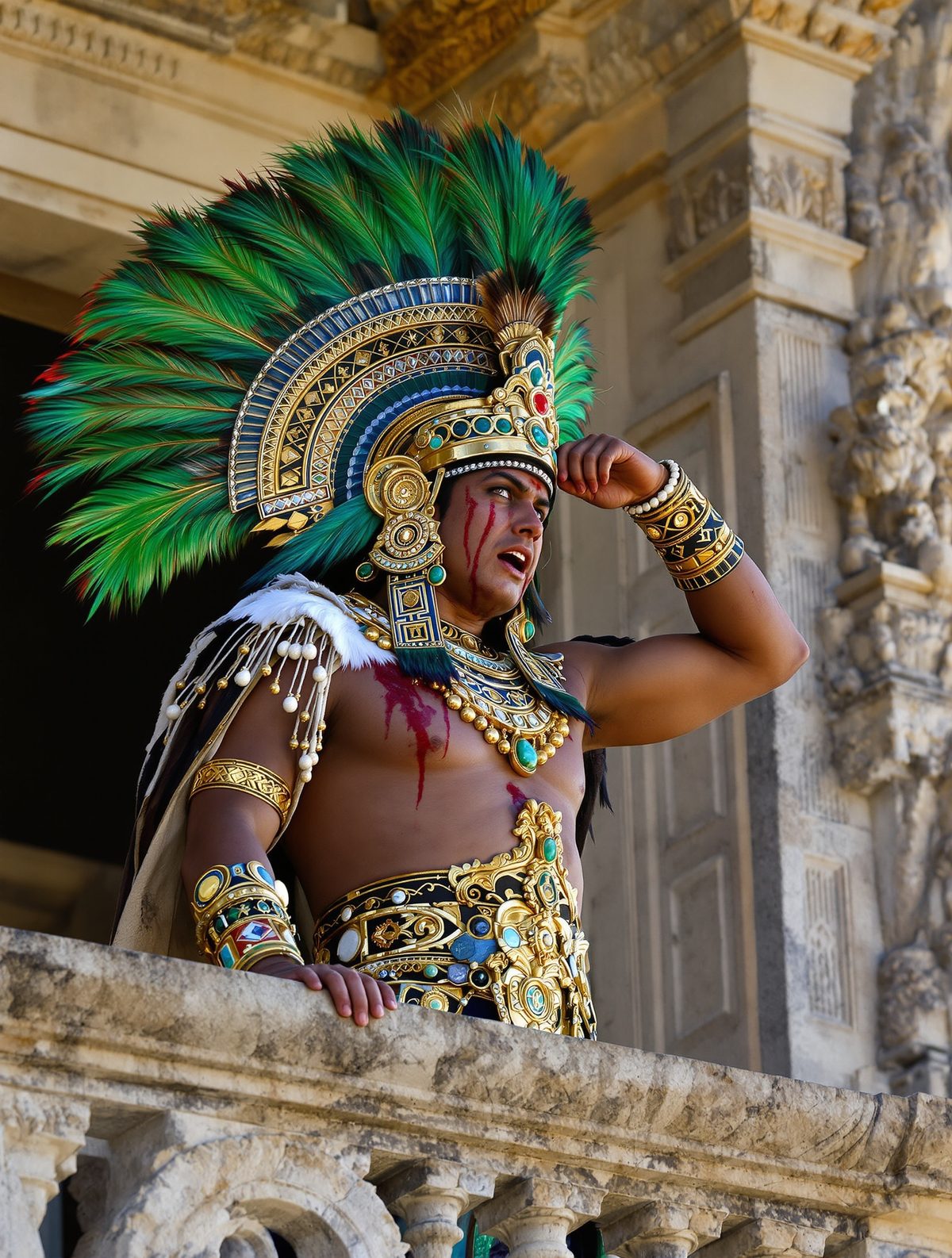
When Moctezuma appeared on the palace balcony on June 30, dressed in his imperial regalia, the crowd's reaction was immediate and brutal. This was not the welcome of subjects greeting their king, but the rage of a betrayed people facing their betrayer. "You are no longer our lord!" they screamed. "You are a woman of the Spaniards!"
The first stones flew before Moctezuma could finish his opening words. One struck him in the head with a sickening crack that Spanish witnesses could hear even over the crowd's roar. More followed—rocks, pottery shards, anything the mob could throw. The man who once couldn't be looked upon directly was pelted with debris by his own subjects.
Spanish soldiers dragged the bleeding emperor back inside, but the damage was done—both physically and symbolically. The divine right of kings had crumbled along with Moctezuma's skull.
Three Days That Changed History
Moctezuma lingered for three days after the stoning, drifting in and out of consciousness as his head wound festered. Spanish accounts claim he refused food and water, tearing off bandages and declaring his desire to die. Aztec accounts, recorded years later, tell a different story—that the Spanish themselves murdered their former puppet when he was no longer useful.
The truth may never be known, but Moctezuma's death on July 2, 1520, marked the end of more than just one man's life. With their emperor gone, the Aztecs chose a new leader: Cuitláhuac, Moctezuma's brother, who had opposed cooperation with the Spanish from the beginning. His first act was to launch an all-out assault on the conquistadors.
What followed was La Noche Triste (The Night of Sorrows), when Cortés and his men fled Tenochtitlan in the darkness, losing hundreds of soldiers and tons of stolen gold to Aztec warriors and the murky waters of Lake Texcoco. The Spanish barely escaped with their lives, and it seemed the Aztec Empire would survive.
But Moctezuma's death had unleashed forces beyond anyone's control. The Spanish would return with thousands of indigenous allies who had suffered under Aztec rule, and they would bring with them an invisible weapon more deadly than any sword: smallpox. Within two years, Tenochtitlan would lie in ruins, and the Aztec Empire would be nothing but memory.
The Stone That Shattered an Empire
Today, Moctezuma II is often remembered as a weak leader who handed his empire to Spanish invaders. But this misses the deeper tragedy of his story. Here was a man trapped between worlds—ancient religious beliefs that demanded he honor possible gods, and political realities that required him to protect his people. His attempt to navigate between these impossible demands ultimately satisfied neither the conquistadors nor his subjects.
The stone that killed Moctezuma represents something profound about the nature of power and legitimacy. No ruler, no matter how absolute their authority, can survive once their people withdraw their consent to be governed. Moctezuma discovered that divine right means nothing when your subjects no longer believe in your divinity.
His death reminds us that history's great turning points often hinge on single moments—a stone thrown in anger, a balcony speech gone wrong, the final straw that breaks an empire's back. In our own age of political upheaval and challenged authority, Moctezuma's fate serves as a stark reminder that no leader is too powerful to fall, and sometimes the greatest threats come not from enemies, but from the very people leaders claim to serve.