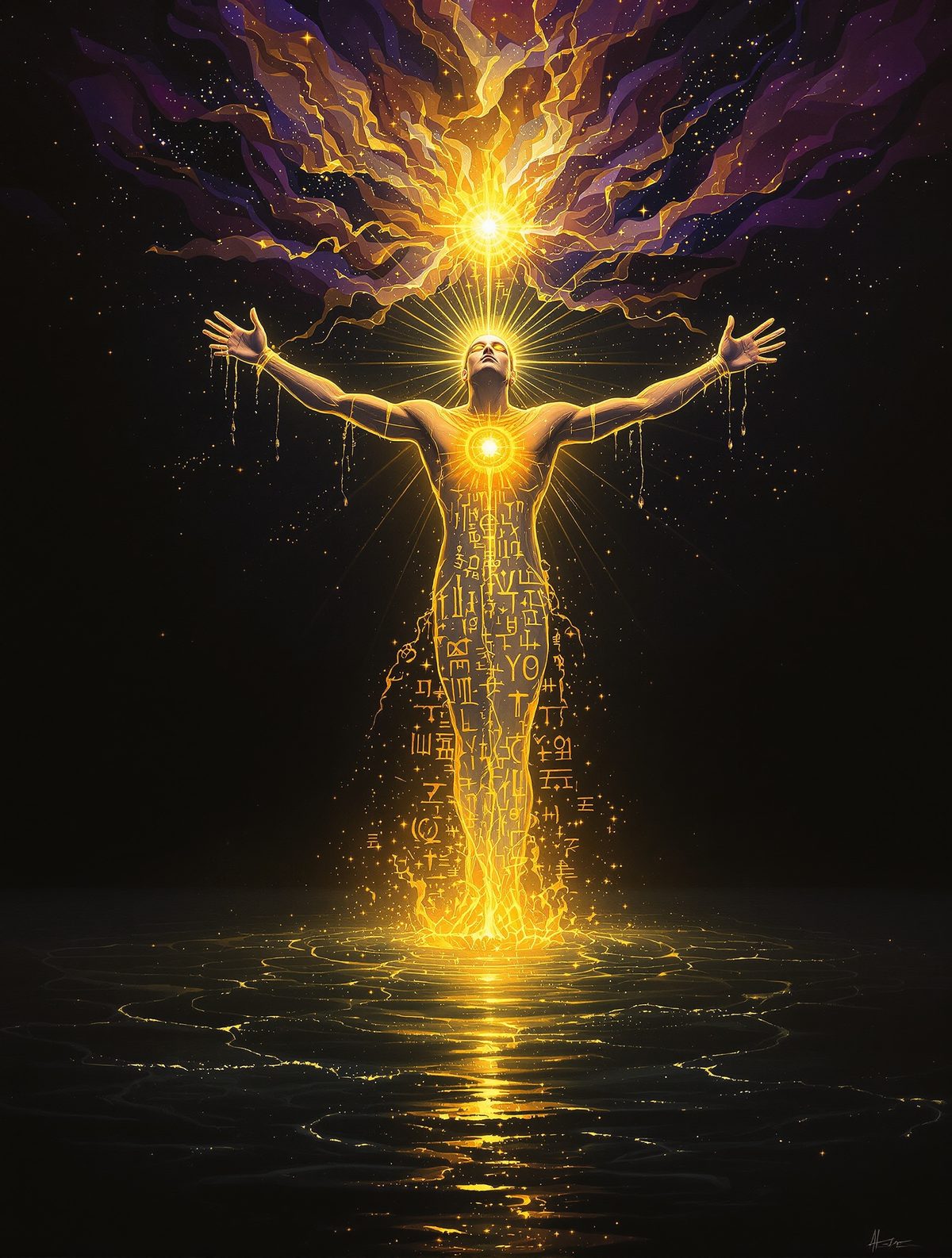
Before the dawn of time, in the heart of an unfathomable eternity, there lay a churning expanse of dark, formless waters known as Nun. These primeval waters whispered of secrets untold, where silence reigned supreme and the concept of reality had yet to draw breath. In this abyss, a glimmer broke the eternal darkness—the impossibility of a god born from void. This is the tale of Atum, the self-created deity of Egyptian mythology, who spoke his own name and breathed life into the universe.
Emergence from the Abyss
The story of Atum's birth is one shrouded in mystique and wonder, a cornerstone of ancient Egyptian cosmology. In the beginning, all was submerged within Nun, the primordial ocean strewn across the gaping maw of nothingness. There was no earth to tread upon, no sky to gaze into—only deep, brooding waters that held the potentials of all things yet to come.
Then, from the solitude of this liquid infinity, Atum came forth spontaneously. He had no progenitors, unbound by the lineage that defines beings of the material world. The ancient Egyptians revered this profound moment; they believed Atum to have pulled himself from the inert waters by the force of his will. This self-creation is a resonant display of divine autonomy, a legacy shared orally as early as 3100 BCE during the rise of the Old Kingdom.
What makes Atum's story so fascinating is how he formed from the mire purely by uttering his name, mediating between chaos and order. This act exemplifies how words themselves held great power in ancient Egypt—a theme deeply embedded in their religion and culture, where speaking invoked action and order from chaos.
Atum's Cosmic Offspring
Alone but undeterred, Atum began shaping the universe through sheer force of will and creative prowess. According to the Pyramid Texts, some of the oldest religious inscriptions known, Atum gave rise to the ancestral gods Shu and Tefnut. Shu embodied the air, filling the expanse above with breath and space, while Tefnut swirled into existence as moisture and dew, guiding the cycles of life and death.
To conceive these offspring, Atum united the dual facets of his being, both male and female, thus symbolizing the origin of life within a singular, self-sufficient entity. Shu and Tefnut's emergence marked the first separation of the waters, a formative breath into the fabric of existence. From there, the narrative of creation continued its divine unfoldment—a continuum where reality knitted itself meticulously from the void.
Through this act, Atum established the Ennead—a sacred group of nine deities that constituted the core pantheon in Heliopolitan theology. This divine family laid the foundations for the cosmos and all living things within it, an integral aspect others might overlook when exploring Egyptian myth.
The Sacred Mound Beckons
In the shadow of chaos, the lands of Egypt stretch across a blistering expanse where sand and river dance an eternal tango. Take an imaginary journey to a place where silence echoes across the Nile’s rippling banks—imagine yourself standing at the stony foot of the benben stone, the sacred mound that rose from Nun and cradled Atum’s first steps. Isolated here, Atum found the stable ground necessary to assert his dominion over the burgeoning universe.
Particularly in the city of Heliopolis, now modern-day Cairo, the benben became the epicenter of worship and relics devoted to the sun god Ra. Yet, many might have forgotten that here, too, once stood the original sanctuary that venerated Atum's first emergence. The Sacred Mound assumed a metaphysical significance, a tangible link to the non-existent past—a point where sacred and mortal might converse.
Atum’s legacy on this ancient stone fostered a culture of reverence where each event in natural life was but a thread woven into the broader tapestry of Atum’s early reign over the cosmos. Worshipers would line their edifices with stones reminiscent of the benben and centered them in their prayers, remembering the god who turned the void into the fertile basin of Egyptian civilization.
Symbolism: Atum as a Dual Deity
The complexity inherent in Atum's mythology presents a multifaceted image of divinity itself. Often depicted with dual aspects, Atum could materialize as the serpent—symbolizing the eternal cycle of rebirth paralleled by the sun’s daily journey through the underworld. His evening voyage was as much an act of regeneration for the world as it was for the gods—a devotion to balance and rebirth.
However, Atum also wore the guise of a man crowned with the pschent, or the double-crown of Upper and Lower Egypt. This regal insignia reflected not only terrestrial dominion but a philosophical interpretation of unity. The logic follows that when Atum called his name from Nun, he became not just the origin but the harmony of opposites—a theological encapsulation of cosmic order.
This symbolic duality sparked intricate rites and ceremonies carried out by priests dedicated to Atum, the sacred care emphasized through titles such as "the closer of lips" or the mysteriously benevolent Lords of Destiny, who invoked his transformative power.
The Undying Legacy of Atum
Even as contemporary science reveals the vast complexities of the universe, the myth of Atum resonates with an eternal truth—creation as an act of conscious intention and potency. This makes us ponder the nature of reality: what latent potential could our world still hold? If a god can emerge autonomously from chaos, then the legacy of purposeful creation dwells within us still.
Myths are more than just stories passed through the corridors of history. They are living, breathing entities of human imagination, possessing the power to invoke reflection and awe, inviting modern-day explorers to delve into the past for wisdom applicable today. Atum’s ascent from the void served not merely as an origin tale but as a philosophical muse for centuries of Egyptian innovation, underscoring the potency of the spoken word when aligned with the will to create.
In retelling the legend of Atum, we're invited to awaken our own worlds from today's chaos, conjuring our destinies from within through strength and intention. As much as the ancients peered into the formless void seeking answers, we too navigate the unknown, whispering our names in solitude, shaping realities from the uncharted vastness ahead.